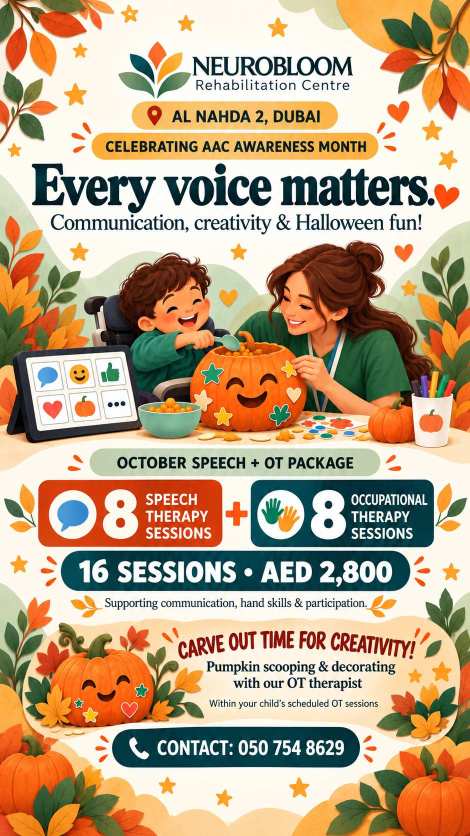
For a child on the autism spectrum, communication is often the primary source of frustration and behavioral outbursts. Applied Behaviour Analysis (ABA) therapy views communication as a “functional behavior”—a tool used to impact the environment. In the multicultural and busy homes of Dubai, helping an autistic child “request” their needs is the first step toward peace and connection. At Neurobloom Rehabilitation Centre, we use ABA to break down the complex process of “talking” into manageable units. We move from “Manding” (requesting) to “Tacting” (labeling), ensuring that every sound or sign has a clear, rewarding purpose for the child.
Strengthening communication involves a high-frequency, “Total Communication” approach. We recognize that verbal speech is just one path; we may use signs, pictures (PECS), or high-tech devices to give the child an immediate voice. By making communication “low-effort” and “high-reward,” we naturally decrease the need for the child to use “challenging behavior” to get their point across. This work is essential for school inclusion; a child who can communicate is a child who can successfully participate in the vibrant academic and social life of the UAE.
The Connection Anchor: Nurturing “Communicative Intent” Through High-Motivation Play
Building a child’s voice is a collaborative mission that turns every interaction into a “social win.” A vital strategy for parents is “Capturing the Motivation”—waiting for the child to truly want something (like a favorite toy or a push on the swing) and then prompting them to use their communication tool to “ask” for it. Parents can support growth by “Modeling the System”—using the same signs or pictures yourself while you talk to the child. This consistent modeling at home, guided by the ABA specialists at Neurobloom Rehabilitation Centre, ensures the child views communication as the ultimate “key” to their world.
Frequently Asked Questions
Will using pictures or signs stop my child from ever speaking?
No. Research shows that “Augmentative Communication” actually boosts verbal speech by reducing frustration and providing a clear model for meaning. It builds the “brain pathways” for communication while the vocal muscles are still developing.
How is ABA communication therapy different from “Standard Speech Therapy”?
While speech therapy focuses on the “mechanics” of sounds, ABA focuses on the “function” and “motivation.” At Neurobloom Rehabilitation Centre, we often combine both to ensure your child has the ability to speak and the desire to use that speech to connect with you in Dubai.
How long does it take for a non-verbal child to start communicating?
Every child’s journey is unique. However, with consistent ABA-based communication training, most families notice a significant increase in “intentional reaching/looking” and a decrease in “frustrated outbursts” within 8 to 12 weeks. The goal is a lifelong voice for the child.
Learn how this therapy can support your child’s growth and daily functioning. Call 0507548629 to speak with our child development team.