
Speech and Language Assessment Dubai: Understanding Your Child’s Communication Clearly and Completely
When words don’t come easily, an assessment reveals what’s happening beneath the surface — and exactly how to help.
You’ve been waiting. Waiting for the first word that hasn’t come. Waiting for the sentences that other children seem to produce effortlessly. Waiting for your child to say their own name clearly, to follow a simple instruction, to tell you what they want without pointing, grunting, or melting down in frustration.
Maybe you’ve been told to “just wait — some children are late talkers.” Maybe you’ve tried to reassure yourself with stories about Einstein. But the waiting has stretched from weeks into months, and the knot in your stomach hasn’t gone away. You know your child has something to say. They just can’t seem to get it out — or they can’t seem to understand what you’re saying to them.
At Neurobloom Rehabilitation Center in Al Nahda, Dubai, our speech and language assessments don’t just count how many words your child has. They provide a deep, detailed understanding of your child’s entire communication system: what they understand, how they express themselves, how they produce speech sounds, how they use language socially, and what’s getting in the way of their progress.
Your child has a voice. Our job is to understand what’s making it hard to use — and to give you a clear plan to help.
[Book a Speech and Language Assessment] [WhatsApp Us: +971 50 754 8629]
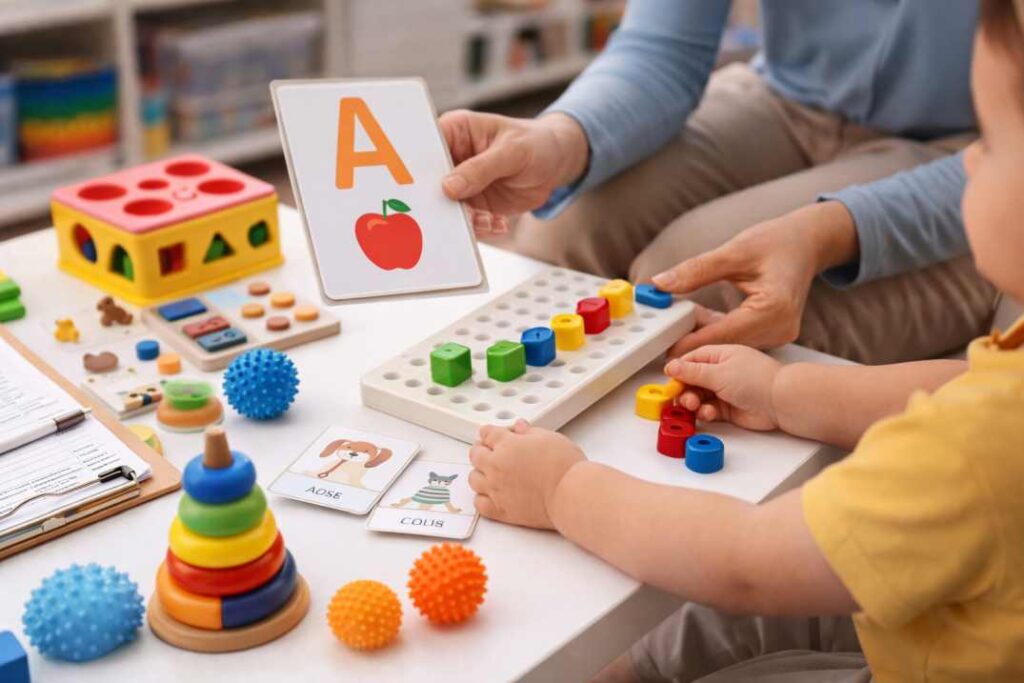


What Is a Speech and Language Assessment?
A speech and language assessment is a comprehensive evaluation of your child’s communication abilities conducted by a qualified speech and language therapist. It examines every component of the communication system — not just the words your child can say.
A quality speech and language assessment evaluates:
- Receptive language:What your child understands — words, sentences, questions, instructions, concepts
- Expressive language:What your child can communicate — vocabulary, sentence structure, grammar, ability to express ideas
- Speech sound production:How clearly your child produces sounds — articulation, phonological patterns, intelligibility
- Fluency:Whether speech flows smoothly or is interrupted by stuttering or other dysfluencies
- Pragmatic/social communication:How your child uses language in social contexts — conversation, turn-taking, reading social cues
- Oral motor function:How the muscles of the mouth, tongue, and jaw work for speech
- Pre-linguistic skills:For young or non-speaking children — eye contact, joint attention, gestures, turn-taking, vocalizations
- Voice:Quality, pitch, volume, and resonance of your child’s voice
The result is not a single score. It’s a detailed profile of your child’s communication strengths and needs, with specific, actionable recommendations.
Signs Your Child May Benefit from a Speech and Language Assessment
Infants and Toddlers (0-2 Years)
- Limited or no babbling by 9 months
- No first words by 15 months
- Fewer than 50 words by 24 months
- Not combining two words by 30 months
- Doesn’t point to objects or pictures when named
- Doesn’t follow simple instructions (“get your shoes”)
- Limited eye contact or joint attention during interactions
- Loss of previously acquired words or sounds
Preschool Children (2-4 Years)
- Speech is difficult for unfamiliar listeners to understand at age 3
- Uses primarily single words when peers are using sentences
- Difficulty following two-step instructions
- Frustration or tantrums related to communication attempts
- Stuttering that has persisted for more than 6 months
- Limited interest in interacting with peers
- Difficulty answering simple “what” and “where” questions
School-Age Children (4-12 Years)
- Speech remains unclear — certain sounds consistently mispronounced
- Difficulty telling a coherent story or describing events in sequence
- Struggles to understand or answer “why” and “how” questions
- Limited vocabulary compared to peers
- Difficulty following classroom instructions
- Problems with reading, spelling, or phonological awareness
- Difficulty with conversation — staying on topic, taking turns, reading social cues
- Stuttering that causes distress or avoidance of speaking situations
- Voice that sounds hoarse, nasal, or unusual
If several of these signs feel familiar, and especially if they’re affecting your child’s daily life — an assessment provides clarity and direction.
Common Speech and Language Diagnoses
While not every assessment results in a formal diagnosis, common communication disorders identified through assessment include:
|
Diagnosis |
What It Means in Simple Terms |
|
Expressive Language Delay/Disorder |
Difficulty using words and sentences to express thoughts and needs |
|
Receptive Language Delay/Disorder |
Difficulty understanding what others say |
|
Mixed Receptive-Expressive Language Disorder |
Difficulty with both understanding and producing language |
|
Phonological Disorder |
Patterns of speech sound errors that affect intelligibility |
|
Articulation Disorder |
Difficulty physically producing specific speech sounds |
|
Childhood Apraxia of Speech |
Difficulty planning and coordinating the mouth movements needed for speech |
|
Stuttering (Developmental Dysfluency) |
Interruptions in the flow of speech — repetitions, prolongations, blocks |
|
Pragmatic/Social Communication Disorder |
Difficulty using language appropriately in social contexts |
|
Voice Disorder |
Problems with pitch, volume, or quality of voice |
|
Oral Motor Dysfunction |
Weakness or coordination problems in the muscles used for speech |
Each underlined diagnosis links to a detailed article explaining it in parent-friendly language.
What If the Assessment Shows Typical Development?
This is a valuable outcome — not a wasted one. If your child’s communication skills fall within the typical range for their age, we’ll explain this clearly and discuss whether any mild areas of difficulty would benefit from monitoring or home strategies. We’ll also discuss what to watch for and when to seek reassessment if concerns persist.
Some children are “late bloomers” who catch up without intervention. Others have subtle difficulties that don’t meet clinical thresholds but still cause frustration. Either way, you’ll leave with clarity and a plan — even if that plan is simply “continue monitoring, and here’s what to look for.”
When Should You Seek a Speech and Language Assessment?
Communication difficulties are among the most common developmental concerns in early childhood — and they are also among the most responsive to early intervention.
Don’t wait if:
- Your child is significantly behind communication milestones for their age
- Your child seems frustrated, withdrawn, or distressed by their communication difficulties
- Your child’s speech is difficult for you — their parent — to understand
- A teacher, pediatrician, or other professional has recommended assessment
- Your child had words and lost them (regression at any age requires immediate assessment)
- You have a persistent gut feeling that something isn’t right
Early intervention works. The brain’s plasticity for language development is greatest in the early years. Children who receive appropriate speech and language support early tend to make faster, more substantial progress than those who wait. But it’s never too late — older children also benefit significantly from assessment and intervention.
Our Approach to Speech and Language Assessment
At Neurobloom, a speech and language assessment is not a quick screen or a vocabulary checklist. It’s a thorough, individualized evaluation that captures the complexity of your child’s communication.
We Use Standardized and Informal Measures
Our assessments draw from a range of internationally recognized, evidence-based tools appropriate to your child’s age, language level, and concerns:
- Standardized language assessments:Norm-referenced tests that compare your child’s performance to that of same-age peers, providing objective data on receptive and expressive language skills
- Speech sound assessments:Systematic evaluation of articulation and phonological processes, identifying which sounds are difficult and what patterns underlie the errors
- Fluency assessment:Detailed analysis of stuttering behaviors — frequency, type, duration, and associated physical tension or avoidance
- Oral motor examination:Assessment of the structure and function of the oral mechanism — lips, tongue, jaw, palate — for speech production
- Language sampling:Analysis of your child’s spontaneous language during play or conversation — the most ecologically valid measure of real-world communication
- Clinical observation:Structured and unstructured observation of your child’s communication across contexts
- Parent interview:Your detailed account of your child’s communication development, current functioning, and the specific concerns that brought you here
We Assess the Whole Communication System, Not Just Speech Sounds
A child who can produce every sound perfectly but cannot put a sentence together has a significant communication need. A child who speaks in complex sentences but is completely unintelligible has a different — but equally significant — need. Our assessments capture the full picture.
We Consider Bilingual Development
Dubai is a multilingual city, and many children we assess speak two or more languages. We understand typical bilingual language development and can differentiate between:
- Normal differences related to learning multiple languages
- A true language delay or disorder present across all languages
- Language loss in one language as another becomes dominant
Assessments can be conducted in English, Arabic, Hindi, or Malayalam. For bilingual children, we gather information about all languages spoken, understanding that a child’s full communication competence may not be captured in a single language.
We Assess Pre-Verbal Communication
For young children who are not yet talking, or for older children who are non-speaking, we don’t simply report “no speech.” We evaluate pre-linguistic skills: joint attention, eye contact, gestures, vocalizations, turn-taking, communicative intent, and use of alternative communication methods. These skills form the foundation on which language is built.
When Should You Seek a Speech and Language Assessment?
Communication difficulties are among the most common developmental concerns in early childhood — and they are also among the most responsive to early intervention.
Don’t wait if:
- Your child is significantly behind communication milestones for their age
- Your child seems frustrated, withdrawn, or distressed by their communication difficulties
- Your child’s speech is difficult for you — their parent — to understand
- A teacher, pediatrician, or other professional has recommended assessment
- Your child had words and lost them (regression at any age requires immediate assessment)
- You have a persistent gut feeling that something isn’t right
Early intervention works. The brain’s plasticity for language development is greatest in the early years. Children who receive appropriate speech and language support early tend to make faster, more substantial progress than those who wait. But it’s never too late — older children also benefit significantly from assessment and intervention.


The Speech and Language Assessment Journey: Step by Step
Step 1: Parent Consultation
Before we meet your child, we meet with you. A detailed conversation covers your child’s developmental history, communication milestones, current concerns, medical history (including hearing), and what you hope the assessment will achieve. You are the expert on your child — we listen carefully.
Step 2: Assessment Session With Your Child
Your child attends 1-2 sessions with the speech and language therapist, depending on their age, attention, and the scope of concerns. Sessions are play-based for younger children and activity-based for older children — designed to feel engaging and comfortable, not like a test. Your child may look at picture books, play with toys, engage in conversation, name objects, follow instructions, or tell stories — all while the therapist systematically evaluates different aspects of communication.
Parents are typically present or nearby, particularly for young children. You may be asked to interact with your child so the therapist can observe natural communication patterns.
Step 3: Analysis and Report Writing
The therapist analyzes all assessment data and produces a comprehensive written report including:
- Your child’s communication profile across all assessed domains
- Standardized scores where applicable, explained in plain language
- Specific speech or language diagnosis if criteria are met
- Your child’s communication strengths
- Detailed, actionable recommendations for therapy, home, and school
- Prognosis and expected therapy timeline if intervention is recommended
Reports are typically ready within 10-14 working days.
Step 4: Parent Feedback Session
We sit with you and walk through every finding. We explain what the scores mean in real terms: how your child’s communication compares to peers, what is typical and what is not, and what progress looks like. We answer every question. And we give you a clear plan — whether that means starting speech therapy, implementing home strategies, monitoring development, or a combination.

How Speech and Language Assessment Connects to Other Services
Communication difficulties often do not exist in isolation. Depending on assessment findings, we may recommend:
- Audiology evaluation:To rule out hearing loss as a cause of speech or language delay
- Occupational therapy assessment:If sensory processing, fine motor, or oral motor concerns are present
- Psychological assessment:If autism, intellectual disability, or selective mutism is suspected
- Feeding therapy assessment:If oral motor difficulties affect both speech and eating
Our multidisciplinary team works under one roof, so if additional assessments are recommended, coordination is seamless.
FAQ
At what age can a speech and language assessment be done?
Assessment can be conducted from infancy onward. For very young children (under 18 months), assessment focuses on pre-linguistic skills, play, social communication, and feeding/oral motor development rather than word counts. Early assessment is valuable even — perhaps especially — when a child is not yet talking.
How long does a speech and language assessment take?
Assessment sessions typically last 60-90 minutes, though this varies by your child’s age, attention, and the scope of concerns. Some children need two shorter sessions rather than one long one. The parent consultation is separate and typically lasts 45-60 minutes.
My child is shy and won't talk to strangers. How can you assess them?
This is very common. Speech and language therapists are skilled at engaging reluctant children through play, following their lead, and creating a comfortable environment. We also rely heavily on parent report and may ask you to interact with your child during the session so we can observe natural communication. If selective mutism is a concern, we adapt our approach accordingly.
Can you assess my child in our home language?
Yes. Our therapists can conduct assessments in English, Arabic, Hindi, and Malayalam. For languages we don’t speak, we gather detailed information from you about your child’s communication in their home language and use this alongside standardized assessment data to form a complete picture.
My child speaks two languages. Will the assessment be accurate?
Yes. We understand typical bilingual language development and assess your child’s total communication competence across languages. Bilingualism does not cause speech or language disorders — a child with a true language disorder will show difficulties in both languages. Our reports clearly distinguish between differences related to bilingualism and signs of a communication disorder.
What's the difference between a speech screening and a full assessment?
A screening is a brief check — usually 15-30 minutes — that identifies whether a child’s communication appears to be developing typically or whether a full assessment is recommended. It does not provide a diagnosis or a detailed profile. A full speech and language assessment is comprehensive, uses standardized measures, and produces a detailed report with specific recommendations.
Will the report help with school accommodations?
Yes. Our assessment reports meet documentation standards for Dubai schools. They can support applications for learning support, speech therapy services within school, and accommodations such as extra time for oral tasks or alternative assessment formats.