
Online Therapy for Children Dubai: Professional Support That Comes to Your Living Room
When coming to a clinic isn’t possible — or isn’t what your child needs right now — we bring therapy to you. Same team. Same expertise. Same commitment. Just through a screen.
Life in Dubai moves fast. Traffic makes a 20-minute journey take an hour. Work schedules don’t always align with clinic hours. Some weeks, the logistics of getting your child to in-person therapy feel overwhelming — and the session you hoped would help becomes another source of stress.
Maybe your child has a medical condition that makes clinic visits difficult. Maybe you live further from Al Nahda than you’d like, and the commute is eating into your family’s limited time together. Maybe your child has sensory sensitivities or social anxiety that make unfamiliar environments overwhelming. Maybe your family travels frequently, and you want consistency of care without interruption. Or maybe you’ve simply realized that your child engages better with therapy in their own space, on their own terms.
Whatever your reason, online therapy at Neurobloom Rehabilitation Center is not a watered-down version of what we do in the clinic. It’s the same evidence-based intervention, delivered by the same DHA-licensed therapists, adapted for an engaging, effective virtual format. And for many children and families, it works beautifully.
Effective therapy doesn’t depend on being in the same room. It depends on the right therapist, the right approach, and the right partnership with you — and all of that can happen wherever you are.
[Book an Online Therapy Consultation] [WhatsApp Us: +971 50 754 8629]
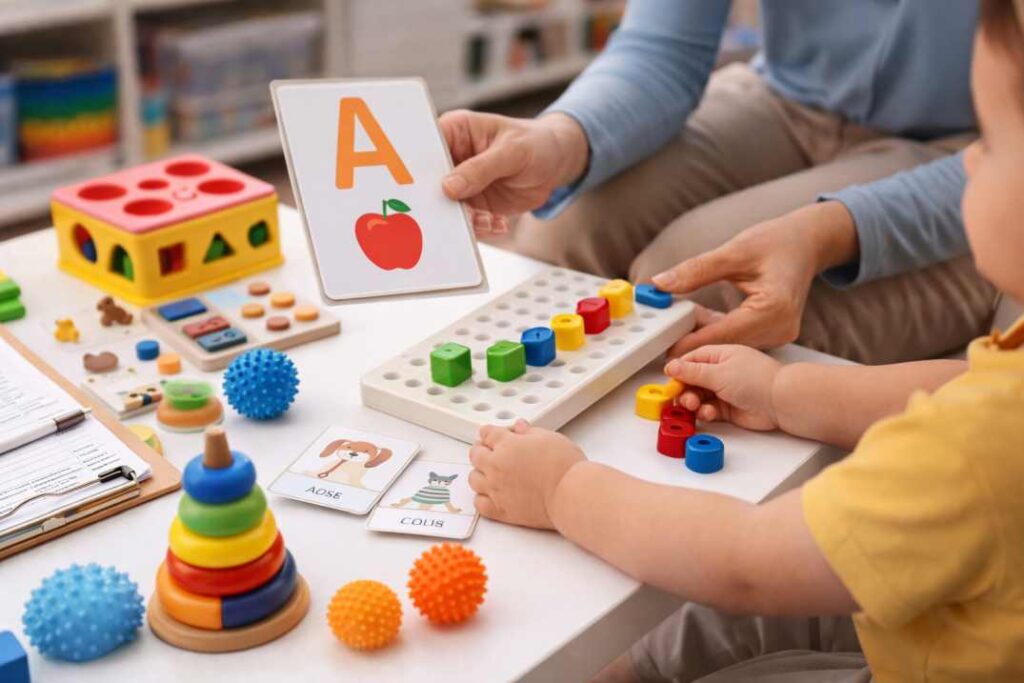


What Is Online Therapy for Children — and How Does It Work?
Online therapy — also called teletherapy or telepractice — is the delivery of speech therapy, occupational therapy, behavioral therapy, parent coaching, or social skills intervention through a secure, HIPAA-compliant video platform. Your child interacts with their therapist in real time, from your home or any quiet, private location with an internet connection.
Online therapy is not pre-recorded videos or self-guided exercises. It’s live, interactive, and personalized. The therapist sees your child. Your child sees the therapist. Activities, games, and materials are shared through the screen or set up in your home with the therapist’s guidance. You are present — actively involved in ways that can actually enhance the therapeutic process beyond what’s possible in a clinic setting.
Online therapy can include:
- Speech and language therapy:Articulation practice, language activities, social communication coaching, fluency strategies
- Occupational therapy:Fine motor activities, sensory regulation strategies, handwriting support, daily living skills coaching
- Behavioral therapy and ADHD support:Executive function coaching, behavioral strategies, parent-mediated intervention
- Parent coaching and training:Learn strategies to support your child’s development across all domains
- Social skills development:Individual social skills coaching as a bridge to in-person group participation
Online therapy is not appropriate for every child or every concern. For example, sensory integration therapy that requires specialized equipment is best delivered in our sensory gym. Feeding therapy involving hands-on oral motor work is more effective in person. We discuss candidly whether online therapy is a good fit for your child’s specific needs during your initial consultation.
Why Families Choose Online Therapy
Convenience Without Compromise
Eliminate travel time, parking, traffic, and waiting rooms. A 45-minute therapy session takes 45 minutes of your day — not two hours. Online therapy works around your family’s schedule, including early mornings, after school, and weekends.
Consistency When Life Is Unpredictable
Illness, travel, relocation within the UAE, or temporary moves abroad no longer mean interrupting your child’s progress. Online therapy provides continuity of care through life’s transitions. Families who travel during school holidays can maintain therapy momentum rather than losing weeks or months of progress.
Comfort in Familiar Surroundings
Some children engage more fully in their own environment. The home setting reduces anxiety, eliminates the overstimulation of a clinic waiting room, and allows the therapist to see your child in the context where many challenges actually occur. For parent coaching and home program implementation, online sessions allow the therapist to guide you in real time, in your actual living space, using your actual materials.
Parent Involvement That Goes Deeper
In clinic-based therapy, you may observe from behind a window or receive a brief summary after the session. In online therapy, you’re often an active participant — setting up activities, practicing strategies under the therapist’s guidance, and learning skills you can implement immediately between sessions. This level of parent involvement can accelerate progress.
Access to Specialized Expertise
Families living in areas of Dubai or the Northern Emirates where specialized pediatric therapy services are limited can access Neurobloom’s multidisciplinary team without geographic barriers. Families in Abu Dhabi, Sharjah, Ajman, Ras Al Khaimah, or further afield can receive consistent, high-quality therapy from DHA-licensed professionals.
What Online Therapy Looks Like in Practice
Speech and Language Therapy Online
Your child’s speech therapist uses a secure video platform with screen-sharing capabilities. For a child working on articulation, the therapist might show visual models of mouth positions, play interactive sound games, or share digital flashcards. For a child working on language, the therapist might read a digital storybook, ask questions, and use virtual manipulatives to build sentences. For a child working on social communication, the therapist might role-play conversations, analyze video clips of social situations, or coach your child through a structured conversation with you.
Younger children or children with shorter attention spans benefit from sessions that incorporate movement, parent facilitation, and frequent activity changes — all of which work well online with a parent present to support.
Occupational Therapy Online
Your child’s occupational therapist guides fine motor, visual-motor, and self-care activities using materials you already have at home. Handwriting practice, scissor skills, and drawing tasks are shared through the camera. The therapist demonstrates techniques, observes your child’s performance, and provides real-time feedback. For sensory regulation, the therapist coaches you in implementing sensory activities — heavy work, movement breaks, deep pressure input — using household items. For daily living skills, the therapist might guide you through a dressing sequence or toothbrushing routine with your child.
Behavioral Therapy and ADHD Support Online
Executive function coaching translates naturally to the online format. Your child’s therapist helps them organize their workspace, plan homework, break tasks into manageable steps, and problem-solve obstacles — all in their actual study environment. Parent coaching sessions for behavior management involve detailed discussion, strategy planning, and review of video examples you may choose to share.
Parent Coaching Online
Parent coaching is one of the most effective online therapy modalities. Without your child present, you and your therapist engage in focused discussion about challenges, learn new strategies, and plan implementation. The online format makes scheduling parent coaching far easier — sessions can occur during your lunch break, after children are in bed, or on weekends.
Technology and Setup: What You Need
Participating in online therapy requires minimal equipment. You need:
- A device with a camera:Laptop, tablet, or desktop computer. Phones can work for some sessions but are not ideal due to small screen size.
- Stable internet connection:Standard home WiFi is typically sufficient.
- A quiet, well-lit space:A corner of a room where your child can see the screen clearly and the therapist can see your child.
- Basic materials:Paper, pencils, crayons, and a few common household items. Your therapist will provide a list of any specific materials needed before each session — nothing expensive or difficult to obtain.
- A parent or caregiver nearby:For young children, a parent needs to be present to facilitate activities and manage attention. For older, more independent children, a parent should be within earshot.
We use a secure, encrypted video platform that complies with healthcare privacy standards. No special software installation is typically required — just a link we send before each session. Our team provides technical support and a test session before your first appointment to ensure everything works smoothly.


Is Online Therapy Right for Your Child?
Online therapy works well for many children — but not all. During your initial consultation, we discuss candidly whether it’s a good fit.
Online therapy tends to work well for:
- Children who are verbal or have emerging verbal skills
- Children who can attend to a screen for meaningful periods (with parent support for younger children)
- Children with mild to moderate speech, language, or motor difficulties
- Parent coaching and consultation
- Executive function coaching for children with ADHD
- Continuation of established therapy relationships during travel or transition
- Families who are highly motivated to participate actively in sessions
Online therapy may be less appropriate for:
- Children with very limited attention who cannot engage with screen-based activities
- Significant behavioral challenges that require hands-on management
- Severe feeding difficulties requiring direct oral motor intervention
- Sensory integration therapy requiring specialized equipment
- Children for whom screen time is already a source of dysregulation or conflict
We never recommend online therapy if we believe your child would be better served in person. Our commitment is to what works best for your child — not to any particular delivery model.

How to Begin: The Online Therapy Process
Step 1: Initial Consultation
We begin with a conversation about your child’s needs, your family’s circumstances, and whether online therapy is appropriate. If your child is new to Neurobloom, we discuss assessment options — which can also be conducted online for speech and language, certain aspects of occupational therapy, and parent interview components. If your child is already receiving in-clinic services with us and wishes to transition some or all sessions online, we discuss the transition plan.
Step 2: Assessment (If Needed)
If your child requires a formal assessment before beginning online therapy, we determine which components can be completed online and which, if any, require an in-person visit. Speech and language assessments, parent interviews, and questionnaire-based assessments translate well to the online format. Hands-on motor assessments may require at least one in-clinic session.
Step 3: Technical Test Session
Before your first therapy session, we schedule a brief technical check. We ensure your device, internet connection, and setup work smoothly. We show you and your child how the platform works. This session is not billed as therapy — it’s our commitment to starting well.
Step 4: Therapy Sessions Begin
Sessions occur at scheduled times via our secure platform. You receive a link before each session. The therapist arrives on time, prepared with a session plan. You and your child engage from your designated space. Sessions typically last 30-60 minutes depending on your child’s age, attention, and therapeutic goals.
Step 5: Ongoing Review and Adjustment
Progress is monitored as carefully online as in person. We track goals, adjust strategies, and communicate with you regularly. If at any point we believe your child would benefit from in-person sessions — even occasionally — we discuss this openly and make adjustments.
Combining Online and In-Person Therapy
Many families find that a hybrid model works best: some sessions online, some in person. Examples include:
- Weekly in-clinic sessions supplemented by online check-ins every other week
- In-clinic therapy during the school term, online therapy during holidays
- Speech therapy online, sensory integration therapy in the clinic
- Parent coaching online, child sessions in person
We are flexible. The right arrangement is whatever serves your child and your family best.
FAQ
Is online therapy as effective as in-person therapy?
Research on telepractice — particularly in speech and language therapy and parent coaching — demonstrates that online delivery can be as effective as in-person intervention for many children and many goals. Success depends on the match between the child’s needs, the therapy approach, and the family’s ability to support the online format — all of which we assess candidly before beginning.
How do you keep my child engaged through a screen?
Therapists use fast-paced, interactive activities designed for the online format. Digital games, screen sharing, movement breaks, and parent-facilitated hands-on activities keep children engaged. Sessions are typically shorter than in-person sessions — 30-45 minutes rather than 60 — to match attention spans. A parent or caregiver is present to support engagement, particularly for younger children.
Can online therapy work for a non-speaking child?
Yes, depending on the goals. For non-speaking children, online therapy often focuses on parent coaching — teaching you strategies to support communication, implement augmentative and alternative communication (AAC) systems, and create communication opportunities at home. The parent is the primary learner, with the therapist guiding and coaching in real time.
My child already has too much screen time. Will online therapy make this worse?
We understand this concern. Online therapy is categorically different from passive screen time. It’s interactive, adult-guided, and purposeful — similar to a video call with a family member. For children where screen time is a significant concern, we discuss strategies to manage overall screen exposure and may recommend fewer but more focused online sessions.
Do you offer online therapy outside the UAE?
Yes, for families who travel frequently or maintain residences abroad, we can provide continuity of care across borders. However, DHA licensing requirements mean we primarily serve families based in the UAE. For families relocating permanently, we support transition planning and can often help identify providers in your new location.
How do I set up my home for a successful online therapy session?
We provide specific guidance before your first session. Key elements: a quiet room with a door that closes, good lighting (natural light facing your child is ideal), a table or desk at your child’s height, and the device positioned stably at eye level. Remove distractions — toys, screens, food — from the immediate area. Your therapist will help you refine the setup during your technical test session.