
Feeding Therapy Dubai: Helping Your Child Eat, Explore, and Enjoy Food
When every meal feels like a battle and your child’s diet shrinks to a handful of “safe” foods, we help them expand what they can eat — without force, without fear, without tears.
You’ve tried everything. You’ve hidden vegetables in pasta sauce. You’ve offered rewards for “just one bite.” You’ve sat at the dinner table for an hour, negotiating, pleading, and eventually giving up and making a separate meal — again. Your child eats five foods. Maybe ten. They gag at new textures. They refuse to eat what the rest of the family is eating. Holidays, birthday parties, and restaurant meals fill you with dread instead of joy.
This is not picky eating. This is not bad parenting. This is a feeding difficulty — and feeding difficulties have real, identifiable causes that can be addressed with the right support.
At Neurobloom Rehabilitation Center in Al Nahda, Dubai, our feeding therapy program is built on respect for your child’s sensory system, oral motor development, and emotional relationship with food. We don’t force, bribe, or coerce. We build trust, skill, and curiosity — one small, supported step at a time.
Your child can learn to eat a wider variety of foods. Mealtimes can become peaceful. Let us show you how.
[Book a Feeding Assessment] [WhatsApp Us: +971 50 754 8629]


What Is Feeding Therapy — and Does My Child Need It?
Feeding therapy is a specialized form of intervention that addresses the physical, sensory, and behavioral factors that interfere with a child’s ability to eat a varied, nutritious diet. It’s delivered by occupational therapists and speech-language pathologists with advanced training in feeding and swallowing.
Feeding therapy is not nutrition counseling. It’s not about telling you what your child should eat. It’s about identifying the root causes of your child’s eating difficulties — whether they’re sensory, oral motor, medical, or behavioral — and systematically addressing them so your child can develop the skills, comfort, and confidence to expand their diet.
Your child might benefit from feeding therapy if you’ve noticed:
- An extremely limited diet — fewer than 15-20 accepted foods
- Refusal of entire food groups (all vegetables, all proteins, all mixed textures)
- Gagging, choking, or vomiting at the sight, smell, or taste of certain foods
- Inability to tolerate certain textures — only eating purees, or only eating crunchy foods
- Difficulty chewing or swallowing; pocketing food in cheeks
- Excessive drooling past infancy
- Refusal to self-feed or use utensils appropriate for their age
- Significant anxiety or distress around new foods or mealtimes
- Mealtimes that consistently last longer than 30-40 minutes
- Weight loss, poor weight gain, or nutritional deficiencies related to restricted eating
- A history of medical issues affecting feeding: reflux, tube feeding, tongue tie, prematurity
When a child’s diet is so limited that it affects their growth, nutrition, social participation, or family functioning — it’s time for professional support.
Feeding Challenges We Address
Feeding difficulties are rarely simple. Multiple factors often interact, and effective therapy addresses all of them.
|
Sensory-Based Challenges |
Oral Motor Challenges |
Behavioral & Emotional Challenges |
|
Tactile defensiveness in the mouth — gags on textures |
Weak oral muscles affecting chewing |
Anxiety around new foods (food neophobia) |
|
Difficulty tolerating mixed textures |
Tongue tie or restricted lingual movement |
History of choking or painful reflux creating fear |
|
Over-sensitivity to food temperatures |
Difficulty moving food around mouth for chewing |
Mealtime power struggles and refusal behaviors |
|
Refusal of foods based on color or appearance |
Open mouth posture or excessive drooling |
Dependence on distractions (screens) to eat |
|
Craves intense flavors or only bland foods |
Difficulty coordinating suck-swallow-breathe |
Rigidity around food presentation or brands |
|
Gags at smell of non-preferred foods |
Fatigue during meals — tires before finishing |
Difficulty transitioning from purees to solids |
Each underlined challenge links to a detailed article explaining it in parent-friendly language.
How We Work: The Neurobloom Approach to Feeding Therapy
Feeding therapy at Neurobloom is built on a core principle: a child cannot learn to eat new foods when they feel afraid, pressured, or overwhelmed. Safety and trust come first. Progress follows.
Step 1: We Conduct a Comprehensive Feeding Assessment
Your child’s feeding journey begins with a thorough assessment that looks at the whole picture — not just what they eat, but why they struggle. Our feeding therapists evaluate:
- Oral motor function:How do the muscles of the mouth, tongue, and jaw work? Can your child chew effectively? Are there structural issues like tongue tie?
- Sensory processing:How does your child respond to different textures, temperatures, tastes, and smells? Is there oral defensiveness? Do they seek or avoid certain sensory inputs?
- Medical history:Has your child had reflux, allergies, constipation, frequent illnesses, or tube feeding that affected their early feeding experiences?
- Behavioral factors:What happens at mealtimes? Are there power struggles? Has eating become a source of anxiety or conflict?
- Nutritional status:What is your child actually consuming? Are there nutritional gaps or concerns about growth?
We also observe a meal or snack — seeing exactly what happens when your child is presented with food.
Step 2: We Build a Personalized Feeding Plan
Based on assessment findings, we develop an individualized plan that addresses the specific barriers affecting your child’s eating. A child with oral motor weakness needs different support than a child with sensory defensiveness. A child with a history of painful reflux needs a different approach than a child whose eating difficulties are primarily behavioral. Most children need a combination of approaches, and our plan reflects that.
Step 3: We Use Systematic, Evidence-Based Approaches
Feeding therapy at Neurobloom draws from multiple evidence-based frameworks, including the Sequential Oral Sensory (SOS) approach, food chaining, and responsive feeding principles. What all these approaches share is a commitment to graded, non-coercive exposure. We don’t ask a child who only eats crackers to suddenly eat broccoli. We start with tiny, manageable steps — perhaps just tolerating the new food on the plate, then touching it, then bringing it to the lips — and build from there at your child’s pace.
Step 4: We Involve You Intimately
Feeding therapy happens once or twice a week. Meals happen every day. That’s why parent involvement is essential. You observe sessions, learn the techniques, and receive specific guidance for implementing strategies at home. We help you set up mealtimes differently, respond to food refusal calmly, and celebrate the small wins that lead to bigger changes over time.
Step 5: We Coordinate With Your Child’s Medical Team
If your child has ongoing medical issues affecting feeding — allergies, gastrointestinal concerns, medication side effects — we communicate with your pediatrician, gastroenterologist, or dietitian to ensure therapy aligns with medical management. Feeding difficulties often sit at the intersection of medical, sensory, and behavioral factors; addressing all three produces the best outcomes.
Is Feeding Therapy Right for Your Child?
We work with children from 6 months to 12 years who:
- Eat an extremely limited range of foods
- Have difficulty with textures, chewing, or swallowing
- Gag, choke, or vomit when presented with non-preferred foods
- Have a diagnosed feeding disorder or avoidant/restrictive food intake pattern
- Have sensory processing challenges that affect eating
- Have oral motor weakness or structural issues affecting feeding
- Have medical conditions (reflux, allergies, tube feeding history) that complicate eating
- Are transitioning from tube feeding to oral feeding
- Experience mealtime anxiety, resistance, or behavioral challenges around food
A formal diagnosis is not required to begin. If mealtimes are a daily struggle and your child’s diet is limited, an assessment can clarify the underlying factors and provide direction.


What a Feeding Therapy Session Looks Like
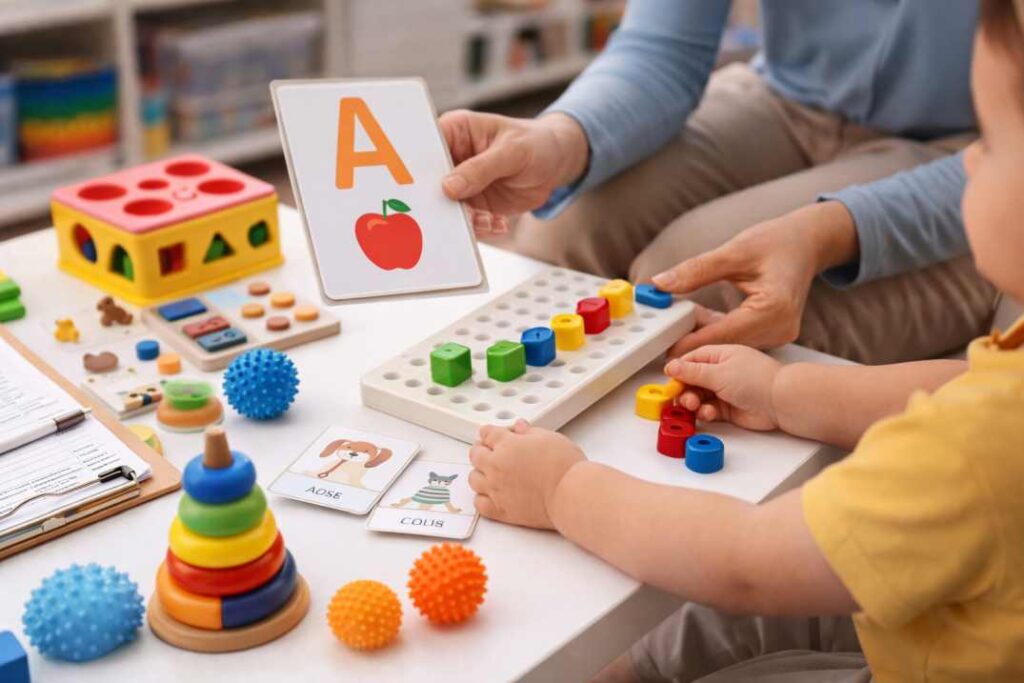
A feeding therapy session is not a forced eating session. It’s a structured, playful, pressure-free environment where your child explores food at their own pace.
The room is set up intentionally. A child-sized table and chair, familiar and non-threatening. Foods are presented in small quantities on neutral-colored plates — never overwhelming portions. The therapist sits at your child’s level, not towering over them. Your child is never strapped into a seat or physically prompted to eat.
The first 5-10 minutes focus on connection and regulation. If your child arrives anxious or dysregulated, the therapist engages them in a preferred, non-food activity first. A regulated child can engage with food. A dysregulated child cannot.
The core 30-35 minutes use systematic desensitization to food. The therapist might introduce a new food through a progression of steps: looking at it, touching it with a utensil, touching it with fingers, smelling it, bringing it to lips, licking it, taking a tiny bite. Your child is in control at every step. No food is ever forced into their mouth. No “just one bite” demands. The therapist models, encourages, and celebrates every interaction — even if the food never enters your child’s mouth during that session.
If oral motor work is needed, the therapist might use oral motor tools, facial massage, blowing games, or chewing practice with safe, non-food oral motor tools before transitioning to food. If sensory defensiveness is the primary barrier, the session might focus on messy play with non-food textures before bridging to food textures.
The final 5-10 minutes are for you. The therapist shares what was worked on, what went well, and one home strategy to practice before the next session. You leave with a clear, manageable next step.

How to Begin: The Feeding Assessment Process
Every feeding therapy journey begins with understanding.
The assessment includes:
- Comprehensive parent interview covering feeding history, current diet, mealtime routines, and specific concerns
- Oral motor examination to assess the function of lips, tongue, jaw, and cheeks
- Meal or snack observation — seeing how your child interacts with preferred and non-preferred foods
- Sensory processing screening related to food textures, temperatures, tastes, and smells
- Review of relevant medical history
- Detailed written report with findings and personalized recommendations
What happens after assessment:
You receive a comprehensive report with your child’s feeding profile, specific therapy recommendations, and initial home strategies. We schedule a parent feedback session to walk through every finding and answer every question. There is no pressure to commit to a specific number of sessions. We provide the information and recommendations — you decide what works for your family.
The Parent’s Role in Feeding Therapy
Feeding therapy cannot succeed without you. The skills and comfort your child develops in sessions must transfer to your dinner table, your kitchen, your daily life.
Here’s what parent involvement looks like:
- You observe sessions to learn techniques firsthand
- You receive specific home strategies after each session — not vague advice, but concrete, doable steps
- You learn how to set up mealtimes to reduce pressure and increase success
- You’re taught how to respond to food refusal calmly and consistently
- You receive guidance on meal planning, food presentation, and bridging from accepted foods to new foods
- You’re supported emotionally — because feeding difficulties are among the most stressful parenting challenges, and your feelings matter
We also offer a dedicated Parent Coaching Program for families who want deeper support around mealtime dynamics and feeding-related anxiety.
FAQ
How do I know if my child is a picky eater or needs feeding therapy?
Typical picky eating is frustrating but tends to be temporary. A child with a feeding difficulty usually eats fewer than 15-20 foods, may lose accepted foods over time without adding new ones, shows extreme distress around new foods, gags or vomits at certain textures, and cannot eat what the family eats. If your child’s diet is so limited it affects their nutrition, social life, or family functioning, an assessment is warranted.
Can feeding therapy help with sensory-based food refusal?
Absolutely. Restricted eating is very common in children with autism, often driven by sensory sensitivities, rigidity around routines, and oral motor differences. Our feeding therapists have extensive experience with children on the spectrum and work in coordination with our autism support team.
How long does feeding therapy take?
This varies significantly. Some children make noticeable progress within 8-12 weeks. Children with more complex feeding histories — tube weaning, severe oral motor challenges, extreme food anxiety — may need longer-term support. We focus on consistent, measurable progress rather than quick fixes.
My child was tube-fed as an infant and now won't eat orally. Can you help?
Yes. Tube-to-oral transitions require specialized, careful intervention. Our feeding therapists have experience supporting children through this process, working closely with your child’s medical team.
Can feeding therapy help with drooling and oral motor weakness?
Yes. Oral motor therapy — strengthening the muscles of the mouth, improving tongue and jaw coordination, and addressing drooling — is often integrated into feeding therapy when assessment indicates these needs.
What ages do you work with for feeding therapy?
We work with children from 6 months (starting solids, transitioning from purees) through 12 years. Feeding difficulties that persist into school age are absolutely treatable.
Do you involve siblings or other family members?
We can, when appropriate. Feeding happens in a family context, and sometimes siblings or other caregivers benefit from understanding how to support your child’s eating. We discuss this on a case-by-case basis.