
Autism Support Dubai: Compassionate, Evidence-Based Care for Your Child
Helping your child connect, communicate, and flourish — at their own pace, in their own way.
Every child with autism experiences the world differently. Some struggle to find words. Some feel overwhelmed by sounds, textures, or lights. Some find social situations confusing or exhausting. And as a parent, you may feel caught between hope and uncertainty — wondering if you’re doing enough, if you’re finding the right help, if your child will be okay.
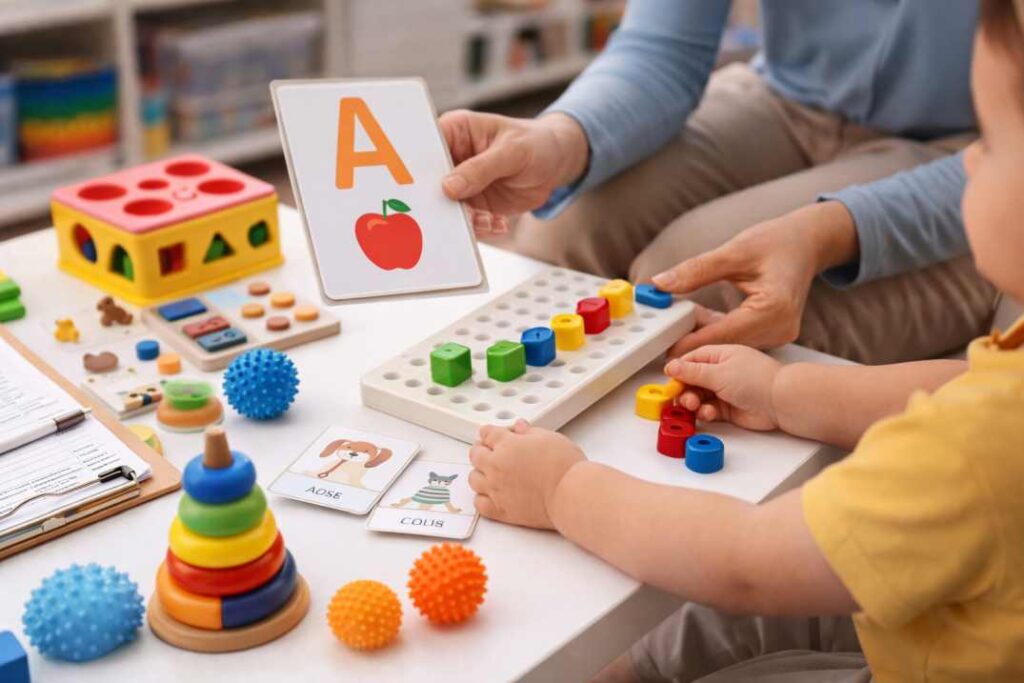


What Is Autism Support — and Does My Child Need It?
Autism support isn’t one thing. It’s a combination of therapies, strategies, and environmental adaptations that help a child with Autism Spectrum Disorder (ASD) navigate daily life with greater ease and confidence.
In simple terms: autism support helps your child build the skills that don’t come naturally to them — whether that’s speaking, playing with other children, managing sensory overwhelm, or handling changes in routine.
Your child might benefit from autism support if you’ve noticed:
- Limited or no eye contact during interactions
- Speech that is delayed, repetitive, or absent
- Intense reactions to sounds, textures, lights, or touch
- Difficulty with changes in routine or transitions
- Preference for solitary play over peer interaction
- Repetitive movements like hand-flapping, rocking, or spinning
- Strong, narrow interests that dominate their attention
Having one or two of these signs doesn’t necessarily mean autism. But if several feel familiar — and especially if they’re affecting your child’s daily life — a professional assessment can bring clarity and direction.
At Neurobloom Rehabilitation Center in Al Nahda, Dubai, we don’t offer a one-size-fits-all autism program. We offer a team that listens first. We get to know your child — their strengths, their challenges, what makes them laugh, what makes them withdraw. Then we build a support plan around them, not around a diagnosis code.
You are not alone in this. And your child is not broken. They simply need a different kind of support — and that’s exactly what we provide.
Conditions and Challenges We Support
Autism rarely travels alone. Many children with ASD also experience co-occurring challenges that need to be addressed together for real progress to happen.
|
Communication Challenges |
Sensory & Motor Challenges |
Behavioral & Emotional Challenges |
|
Speech delay or non-speaking |
Sensory processing difficulties |
Emotional dysregulation and meltdowns |
|
Echolalia (repeating words/phrases) |
Fine motor delays (writing, using utensils) |
Difficulty with transitions |
|
Difficulty with conversation |
Gross motor delays (coordination, balance) |
Self-stimulatory behaviors (stimming) |
|
Literal understanding of language |
Tactile defensiveness (aversion to touch/textures) |
Elopement or wandering |
|
Difficulty reading social cues |
Feeding aversions and restricted eating |
Sleep difficulties |
Each underlined condition links to a detailed article that explains it in parent-friendly language — because understanding what your child is experiencing is the first step to helping them.
How We Work: The Neurobloom Approach to Autism Support
We don’t believe in pulling a child into a clinical room, running drills, and sending them home. Real progress happens when therapy feels like play, when parents are partners, and when every therapist on your child’s team talks to each other.
Step 1: We Listen and Observe
Before we plan anything, we spend time with you and your child. We ask about your observations, your concerns, your child’s strengths. We watch how your child plays, communicates, and responds to their environment. No rushed assessments. No clipboard-only evaluations.
Step 2: We Build a Personalized Plan
Autism support at Neurobloom isn’t a pre-packaged program. Your child’s plan might include speech therapy, occupational therapy, ABA therapy, sensory integration, social skills groups, or a combination — whatever actually meets their needs. We coordinate across disciplines so your child gets consistent support, not conflicting approaches.
Step 3: We Deliver Therapy Through Connection
Sessions happen in warm, sensory-friendly rooms designed to feel safe, not clinical. Our therapists follow your child’s lead — building on their interests to teach new skills. If your child loves dinosaurs, we use dinosaurs to practice speech sounds. If they need movement, we incorporate swings and climbing into learning. Therapy shouldn’t feel like work for a child.
Step 4: We Make You a Partner, Not a Spectator
You are the most important person in your child’s life. We train you in the strategies we use during sessions so you can reinforce them at home, at the park, during bedtime routines. We provide parent coaching sessions, home program materials, and ongoing communication between sessions.
Step 5: We Track, Adjust, and Celebrate
Progress isn’t always linear with autism — and that’s okay. We track small wins: the first spontaneous word, the first successful playdate, the first time your child handles a change in routine without melting down. We adjust the plan as your child grows, and we celebrate every milestone, however small it may seem.
Is Autism Support Right for Your Child?
-
We work with children from 18 months to 12 years who are:
- Formally diagnosed with Autism Spectrum Disorder
- Showing signs of autism and awaiting formal diagnosis
- Displaying social communication challenges without a specific diagnosis
- Struggling with sensory processing, emotional regulation, or daily routines
Whether you have a confirmed diagnosis or are simply a parent who knows something doesn’t feel quite right — you are welcome here. Early intervention makes a profound difference, but it’s never too late to start.


What an Autism Support Session Looks Like
Let us walk you through a typical session so you and your child know exactly what to expect.
Your child will be greeted by name at the door by their therapist — the same person each time, because consistency and trust matter. The room is softly lit, organized, and free of clutter. A visual schedule on the wall shows what will happen during the session, helping your child feel secure in the routine.
The first 10 minutes are about settling in. Your child might spend time on a swing, bounce on a therapy ball, or engage in a preferred activity. This isn’t wasted time — it’s sensory regulation that prepares their nervous system for learning.
The core 30-35 minutes focus on the day’s goals. If speech is a target, the therapist might use a favorite toy to model words, wait expectantly for your child to initiate communication, or use picture cards to build sentences. If sensory needs are high, the session might involve heavy work activities, deep pressure input, or movement breaks between learning tasks. If social skills are the focus, two children might practice taking turns in a guided play activity.
The final 5-10 minutes are for you. The therapist briefly shares what worked, what was challenging, and one strategy to try at home before the next session. You leave with a clear understanding of what happened and what comes next.

How to Begin: The Autism Assessment Process
Every autism support journey at Neurobloom starts with understanding. We offer two pathways:
Pathway 1: Your Child Already Has a Diagnosis
If your child has been diagnosed with ASD by a qualified professional, we begin with our own multidisciplinary evaluation. This isn’t because we don’t trust the diagnosis — it’s because we need to understand your child’s unique profile to build the right plan. This evaluation typically spans 1-2 sessions across relevant disciplines.
Pathway 2: You’re Seeking a Diagnosis
If your child is showing signs of autism but hasn’t been formally assessed, we conduct a comprehensive diagnostic assessment using gold-standard tools including the ADOS-2 (Autism Diagnostic Observation Schedule) and detailed parent interviews. A full diagnostic report is provided, which can be used for school accommodations, insurance purposes, and therapy planning.
What happens after assessment:
You receive a detailed report within 7-10 working days. We then schedule a parent meeting to discuss findings, answer every question you have, and collaboratively build your child’s therapy plan. There is no pressure to commit to a specific number of sessions. We give you the information and let you decide.
Your Role as a Parent
You are not a bystander in your child’s autism support journey. Research consistently shows that children make the most progress when parents are actively involved.
Here’s what parent involvement looks like at Neurobloom:
- You’re welcome to observe sessions (through a one-way mirror or in-room, depending on your child’s needs)
- You receive a brief update after every session with one home strategy to practice
- Monthly parent coaching sessions help you problem-solve specific challenges at home
- You receive resources: visual schedules, social stories, communication boards
- You join a community of parents walking a similar path
We also hold space for your emotions — the grief, the worry, the exhaustion, the hope. Parent coaching isn’t just about strategies. It’s about supporting you so you can support your child.
FAQ
How do I know if my child needs autism support?
If your child struggles with communication, social interaction, sensory processing, or rigid behaviors that interfere with daily life, an assessment can clarify whether autism support would be beneficial. Trust your instincts — parents usually know when something isn’t quite right.
What's the best age to start autism support?
Earlier is better. The brain is most adaptable in the early years, and research shows that early intervention (ideally before age 5) leads to the best outcomes. That said, children can benefit at any age — it is never too late to start.
How many sessions per week does my child need?
This varies widely. Some children attend 2-3 sessions per week across different therapies. Others need more intensive support. We recommend based on your child’s profile, your family’s schedule, and what’s sustainable for you.
Do you offer autism support in Arabic?
Yes. Several of our therapists are fluent Arabic speakers, and therapy can be delivered in Arabic, English, or a combination of both.
What's the difference between ABA therapy and autism support?
ABA (Applied Behavior Analysis) is one specific type of therapy often used in autism support. Autism support at Neurobloom is broader — it may include ABA, speech therapy, occupational therapy, sensory integration, social skills training, and parent coaching, all working together.
Can you help if my child doesn't have a formal autism diagnosis?
Absolutely. Many children we work with show traits of autism without a formal diagnosis. We provide support based on need, not paperwork. We can also conduct the diagnostic assessment if you choose.
Do you provide home-based or centre-based autism support?
Our primary services are centre-based in Al Nahda, Dubai. We also offer a Home Therapy Programme for families who prefer therapy in their home environment, and Online Therapy options for certain services.
How long until we see results?
Every child is different. Some parents report noticeable changes within 4-6 weeks. For others, progress is slow and steady over months. We focus on consistent, measurable progress rather than quick fixes — and we celebrate the small wins along the way.
Ready to Take the First Step?
We know this moment — the one where you’re searching for answers, reading every page you can find, trying to figure out what’s best for your child — can feel overwhelming. You don’t have to figure it out alone.
Whether your child has a diagnosis or you’re simply a parent with questions, we’re here. No pressure. No obligation. Just a conversation about your child and how we might help.