
Autism Support Dubai: Compassionate, Evidence-Based Care for Your Child
Because your child isn’t “naughty” or “difficult” — their brain simply works differently. And we know how to help.
You’ve probably heard it from teachers, relatives, even strangers in the supermarket. “He just needs more discipline.” “She’s so smart, why doesn’t she just pay attention?” “You should be stricter.” And every time, a part of you wants to scream — because you know your child isn’t choosing to struggle. You see how hard they try. You see the frustration, the tears, the exhaustion after holding it together all day at school, only to collapse into a meltdown the moment they walk through the door.
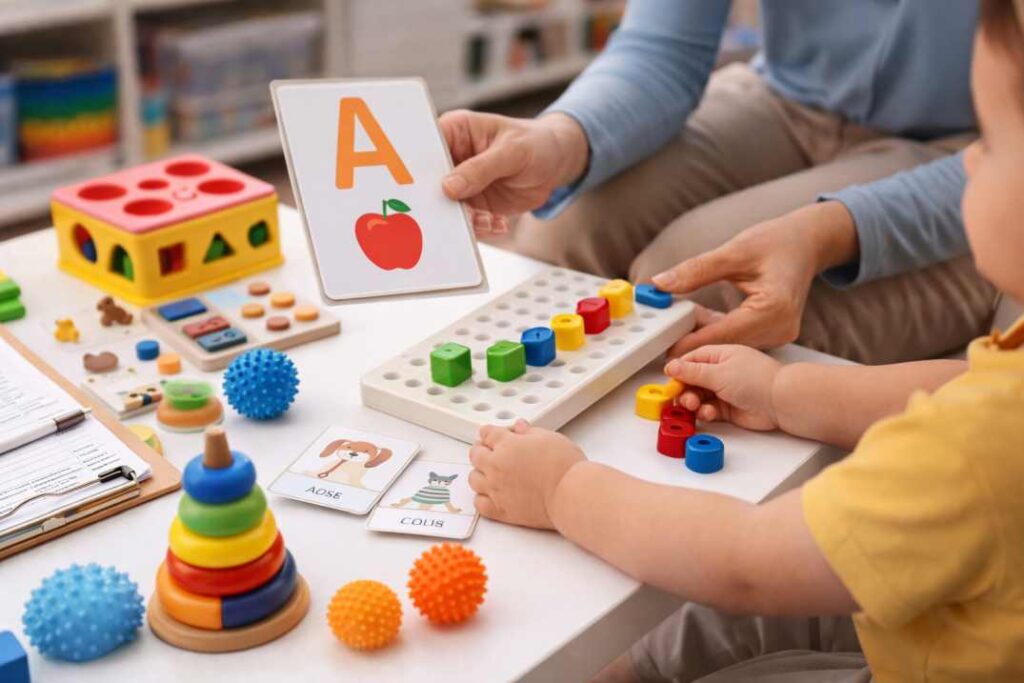


What Is ADHD — and Does My Child Need Assessment Screening Test?
ADHD support is not about “fixing” your child. It’s about giving them — and you — the tools to work with their brain, not against it. It combines therapeutic interventions, environmental strategies, and skill development to address the core challenges of Attention Deficit Hyperactivity Disorder.
In plain language: ADHD support helps your child learn to manage their attention, control their impulses, organize their thoughts and belongings, and regulate the big emotions that can erupt without warning.
Your child might benefit from ADHD support if you’ve noticed:
- Difficulty staying focused on tasks, especially those that aren’t highly interesting to them
- Frequent careless mistakes in schoolwork despite understanding the material
- Seeming not to listen when spoken to directly
- Struggling to follow multi-step instructions
- Losing things constantly — stationery, water bottles, homework, jackets
- Fidgeting, squirming, or difficulty staying seated when expected to
- Running, climbing, or being constantly “on the go” in inappropriate situations
- Talking excessively, interrupting others, blurting out answers
- Difficulty waiting their turn in games or conversations
- Emotional outbursts that seem disproportionate to the situation
- Trouble falling asleep or staying asleep
Every child shows some of these behaviors sometimes. What distinguishes ADHD is the frequency, intensity, and duration — and the fact that these patterns significantly impact daily life across multiple settings: home, school, and social situations.
Conditions and Challenges We Address Alongside ADHD
ADHD rarely exists in isolation. Many children with ADHD also face co-occurring challenges that need to be understood and treated together. Treating ADHD in a silo often leads to incomplete progress.
|
Attention & Learning |
Emotional & Behavioral |
Motor & Sensory |
|
Executive dysfunction (planning, organizing) |
Emotional dysregulation and meltdowns |
Fine motor delays (poor handwriting) |
|
Auditory processing difficulties |
Anxiety and excessive worry |
Gross motor coordination challenges |
|
Specific learning difficulties |
Oppositional or defiant behaviors |
Sensory processing differences |
|
Working memory challenges |
Sleep difficulties and bedtime resistance |
Restlessness and constant movement |
|
Task initiation and completion problems |
Low frustration tolerance |
Difficulty sitting still without fidgeting |
|
Time blindness and chronic lateness |
Social skills challenges with peers |
Impulsive physical risk-taking |
Each underlined condition links to a detailed article that explains it in parent-friendly language. Understanding the full picture of your child’s needs is essential to providing effective support.
How We Work: The Neurobloom Approach to ADHD Support
We don’t believe in a one-size-fits-all ADHD program. Some children need help with focus. Others need support managing emotions. Many need both. Our approach is built around your child — their specific profile, their strengths (yes, strengths — children with ADHD are often remarkably creative, energetic, and capable of hyperfocus on topics they love), and the areas where they genuinely struggle.
Step 1: We Understand Before We Intervene
Your child’s journey begins with a comprehensive ADHD assessment. This isn’t a 15-minute checklist. It’s a thorough evaluation that includes clinical interviews with parents, standardized rating scales, direct observation of your child, and — with your consent — input from teachers. We want to understand how your child functions across different settings, because ADHD often looks different at school than it does at home.
Step 2: We Build a Multi-Disciplinary Plan
ADHD support at Neurobloom draws from multiple disciplines working in coordination. Your child’s plan may include behavioral therapy to build self-regulation skills, occupational therapy to address sensory and motor needs, speech therapy if language or social communication is affected, parent coaching to equip you with home strategies, and coordination with your child’s school. We don’t work in silos — your child’s OT talks to their behavioral therapist, who updates the parent coach. You get a unified team, not fragmented care.
Step 3: We Teach Skills, Not Just Manage Behaviors
Traditional ADHD interventions often focus on suppressing “undesirable” behaviors. We focus on building skills. Your child learns what executive function is (in child-friendly language), how to recognize when they’re becoming dysregulated, and what strategies they can use independently. We use games, movement, role-play, and real-life scenarios — not worksheets and lectures. A child learning impulse control might practice during a board game. A child working on organization might plan and execute a simple recipe.
Step 4: We Partner With You, Because You’re the Constant
You spend far more time with your child than any therapist ever will. That’s why parent involvement is not optional — it’s central. We provide specific, practical strategies for home: how to give instructions your child can actually follow, how to set up a homework routine that minimizes battles, how to respond to meltdowns in ways that de-escalate rather than inflame. You’re not just informed — you’re trained, supported, and empowered.
Step 5: We Coordinate With Schools
With your permission, we communicate directly with your child’s school — sharing relevant assessment findings, recommending classroom accommodations, and providing strategies for teachers. We understand the Dubai school system, including KHDA guidelines and the range of curriculum options (British, American, IB, Indian). We help you advocate for what your child needs: preferential seating, movement breaks, extended time on tests, or reduced homework load.
Is ADHD Support Right for Your Child?
We work with children from 3 to 12 years who are:
- Formally diagnosed with ADHD (inattentive, hyperactive-impulsive, or combined type)
- Showing significant attention, impulse control, or hyperactivity challenges without a formal diagnosis
- Struggling with executive function skills (organization, time management, task completion)
- Experiencing emotional dysregulation that affects daily life
- Having difficulty at school despite being clearly intelligent and capable
A formal diagnosis is not required to begin support. If your child is struggling, we start with an assessment and build a plan based on need, not labels. If a diagnosis is warranted, we provide comprehensive diagnostic services with full reports suitable for school accommodations and insurance purposes.


What an ADHD Support Session Looks Like
No two sessions are identical — because no two children with ADHD are identical. But here’s a glimpse into what your child might experience.
Your child arrives and is greeted warmly by their therapist — the same person each time, because consistency and predictability matter enormously for children with ADHD. The session room is organized but not sterile. Visual schedules, timers, and clear expectations are posted where your child can see them.
The first 5-10 minutes are a check-in and regulation period. If your child arrives dysregulated from school or traffic, the therapist doesn’t push straight into work. They might offer heavy work activities (carrying weighted items, wall pushes), a few minutes on a swing, or a brief movement break. A regulated nervous system is capable of learning. A dysregulated one is not.
The core 30-35 minutes focus on the day’s specific goals — but delivered through engaging activities, not drills. If the target is sustained attention, your child might play a game that requires focus for progressively longer periods, with the therapist tracking and celebrating small improvements. If impulse control is the goal, the therapist might use a “stop and think” game where your child practices pausing before responding. If emotional regulation is the target, the session might involve identifying emotions in stories, role-playing calming strategies, or creating a personalized “calm-down kit.”
Throughout, the therapist uses immediate, specific praise: not “good job,” but “I noticed you stopped yourself from interrupting just then — that took real self-control.” Children with ADHD often receive far more criticism than praise in their daily lives. We intentionally tip that balance.
The final 5-10 minutes are for parent connection. The therapist briefly shares what was worked on, one strategy to try at home, and answers any questions. You leave knowing what happened and what to do next.

How to Begin: The ADHD Assessment Process
Every ADHD support journey at Neurobloom starts with understanding. We offer two entry points:
Pathway 1: Your Child Already Has an ADHD Diagnosis
If your child has been diagnosed with ADHD by a qualified professional, we begin with our own multidisciplinary intake evaluation. This is not because we doubt the diagnosis — it’s because we need to understand your child’s unique strengths and challenges across domains to build the right intervention plan. This typically involves 1-2 sessions with relevant team members.
Pathway 2: You’re Seeking Clarity About Possible ADHD
If your child is showing signs of ADHD but hasn’t been formally assessed, we offer comprehensive diagnostic evaluations. Our ADHD assessment process includes:
- Detailed clinical interview with parents covering developmental history and current concerns
- Standardized ADHD rating scales (completed by parents and, with consent, teachers)
- Direct clinical observation and interaction with your child
- Assessment of co-occurring conditions (anxiety, learning difficulties, sensory issues)
- Comprehensive written report with diagnosis (if criteria are met) and detailed recommendations
What happens after assessment:
You receive a full report within 7-10 working days. We schedule a dedicated feedback session — not a rushed phone call — where we walk through findings, answer every question, and collaboratively build your child’s support plan. There is no pressure to commit to any specific number of sessions. You decide what feels right for your family.
Your Role as a Parent
Parenting a child with ADHD can feel exhausting, isolating, and at times, overwhelming. You may find yourself repeating instructions endlessly, managing daily battles over homework and routines, or fielding complaints from school. You may also carry guilt — wondering if you’re doing something wrong, if you should be more patient, more structured, more something.
Let us say this clearly: ADHD is not caused by parenting. And you are not failing.
Your involvement in your child’s ADHD support is one of the most powerful predictors of positive outcomes. Here’s what parent involvement looks like at Neurobloom:
- You receive specific, actionable home strategies after every session
- Monthly parent coaching sessions address your chosen priorities — morning routines, homework battles, screen time limits, sibling dynamics
- You learn about ADHD from a brain-based perspective, which reduces blame and increases empathy
- You’re connected with resources: visual schedules, routine charts, emotion regulation tools
- You’re supported emotionally — because your wellbeing matters too
We also offer a dedicated Parent Coaching Program for families who want deeper, more structured support in learning to parent a child with ADHD effectively and compassionately.
FAQ
How do I know if my child has ADHD or is just an energetic child?
The key distinction is impairment across multiple settings. An energetic child can settle when the situation requires it, follow instructions when motivated, and function well at school and in social situations. A child with ADHD struggles with attention, impulse control, or hyperactivity to a degree that significantly impacts their learning, relationships, or daily functioning — and this pattern persists over time. If you’re unsure, an assessment provides clarity.
What age can ADHD be diagnosed?
ADHD can be reliably diagnosed from around age 4-5, though symptoms must be present before age 12. For preschool children, we focus heavily on parent training and environmental strategies before considering formal diagnosis. Early intervention — whether or not a formal diagnosis is made — can significantly improve outcomes.
How many therapy sessions per week does my child need?
This varies based on your child’s needs and your family’s capacity. Some children attend 1-2 sessions per week. Others benefit from more intensive support initially, tapering down as skills develop. We recommend based on assessment findings and your family’s schedule — never based on a predetermined package.
What's the difference between ADHD support and behavioral therapy?
Behavioral therapy is one component of ADHD support. Our ADHD support program is broader — it may include behavioral strategies, occupational therapy for sensory and motor needs, speech therapy for social communication, executive function coaching, parent training, and school coordination.
Will my child outgrow ADHD?
ADHD is a neurodevelopmental condition, not a phase. However, with appropriate support, children with ADHD develop strategies, self-awareness, and coping skills that can dramatically reduce its impact on their lives. Many adults with ADHD live highly successful, fulfilling lives. The goal is not to “cure” ADHD — it’s to equip your child with the tools to manage it effectively.
How do you coordinate with my child's school?
With your written consent, we communicate directly with teachers and school support staff. We provide classroom accommodation recommendations, share relevant assessment findings, and offer strategies tailored to your child’s specific school environment. We understand Dubai’s diverse school landscape and can advise on curriculum considerations.