
ADHD Assessment for Children Dubai: Clarity About Attention, Impulsivity, and Your Child’s Potential
Your child isn’t lazy, unmotivated, or “choosing” not to focus. An ADHD assessment helps you understand what’s really going on — and what to do about it.
You’ve heard it before. “She just needs to apply herself.” “He’s so smart — if only he’d pay attention.” “Maybe if you were stricter at home.” Teachers send notes about incomplete work, daydreaming, or disruptive behavior. Relatives offer unsolicited opinions. And you’re caught in the middle — defending your child while secretly wondering if maybe, somehow, this is your fault.
Meanwhile, your child is struggling. Homework that should take twenty minutes consumes the entire evening. Simple instructions need to be repeated five times. Emotions erupt without warning over seemingly small things. Your child loses jackets, water bottles, homework, and sometimes their own train of thought. You can see they’re bright — genuinely bright — but something is getting in the way.
At Neurobloom Rehabilitation Center in Al Nahda, Dubai, our ADHD assessments don’t just answer “does my child have ADHD?” They provide a comprehensive understanding of your child’s attention, impulse control, executive function, and emotional regulation — along with a clear, actionable plan for support.
You’re not failing. Your child isn’t failing. There’s an explanation — and we’ll help you find it.
[Book an ADHD Assessment Consultation] [WhatsApp Us: +971 50 754 8629]
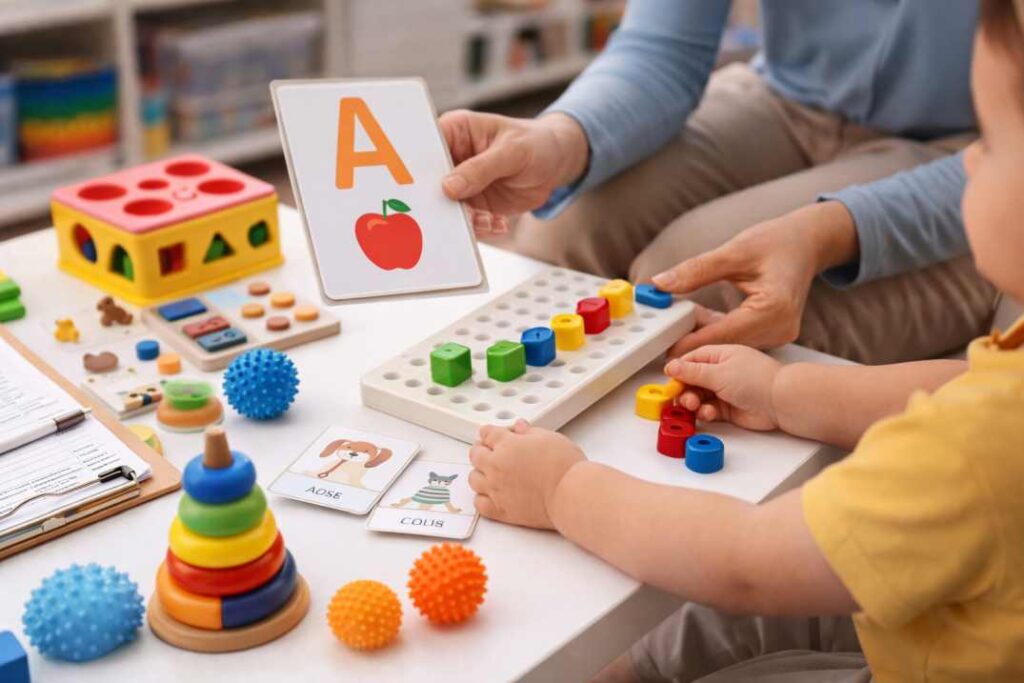


What Is an ADHD Assessment?
An ADHD assessment is a comprehensive evaluation designed to determine whether a child meets diagnostic criteria for Attention Deficit Hyperactivity Disorder — and crucially, to understand the full picture of how your child thinks, learns, and functions across different settings.
A proper ADHD assessment is not a 15-minute checklist or a quick conversation with a pediatrician. It is a thorough, multi-method evaluation that gathers information from multiple sources, uses standardized assessment tools, and rules out other conditions that can mimic or overlap with ADHD.
A quality ADHD assessment distinguishes between:
- ADHD, inattentive presentation (difficulty focusing, easily distracted, forgetful, disorganized)
- ADHD, hyperactive-impulsive presentation (constantly on the go, fidgety, interrupts, acts without thinking)
- ADHD, combined presentation (significant symptoms of both inattention and hyperactivity-impulsivity)
- Conditions that can look like ADHD but aren’t — anxiety, sleep disorders, learning difficulties, sensory processing issues
- Conditions that commonly co-occur with ADHD — anxiety, oppositional behavior, learning disorders, autism traits
The goal is not a label. It’s understanding. Understanding your child’s brain, their challenges, their strengths, and exactly what kind of support would help them thrive.
Signs That May Indicate an ADHD Assessment Is Needed
Every child shows some of these behaviors occasionally. What distinguishes ADHD is the frequency, intensity, and persistence of symptoms — and the fact that they significantly impair functioning across multiple settings.
Inattention Signs
- Makes careless mistakes in schoolwork despite understanding the material
- Difficulty sustaining attention during tasks or play — switches activities frequently
- Seems not to listen when spoken to directly, even when hearing is normal
- Fails to follow through on instructions — starts tasks but doesn’t finish them
- Difficulty organizing tasks and belongings — chronically messy, loses things constantly
- Avoids or dislikes tasks requiring sustained mental effort (homework, reading)
- Easily distracted by external stimuli — noises, movements, own thoughts
- Forgetful in daily routines — forgets chores, homework, appointments, belongings
Hyperactivity-Impulsivity Signs
- Fidgets with hands or feet, squirms in seat, cannot sit still when expected to
- Leaves seat in situations where remaining seated is expected
- Runs about or climbs in situations where it’s inappropriate (in older children, may be limited to feeling restless)
- Difficulty playing or engaging in activities quietly
- Often “on the go” or acting as if “driven by a motor”
- Talks excessively — seems to have no “off” switch
- Blurts out answers before questions are completed
- Difficulty waiting their turn in conversations, games, or lines
- Interrupts or intrudes on others — butts into conversations, takes over games
Executive Function Signs (Often Present With ADHD)
- Chronically disorganized — backpack, desk, room are chaotic
- Poor time management — consistently late, underestimates how long tasks take
- Difficulty starting tasks — procrastinates, avoids, needs constant prompting
- Difficulty holding information in mind while using it (working memory)
- Emotional dysregulation — intense reactions that seem disproportionate
- Difficulty shifting between tasks or adapting when plans change
If several of these signs are present, have persisted for at least six months, and are affecting your child’s academic performance, social relationships, or family life — an ADHD assessment is warranted.
Our Approach to ADHD Assessment
At Neurobloom, an ADHD assessment is thorough, evidence-based, and designed to capture the complexity of your child’s functioning — not reduce them to a score on a rating scale.
We Use Standardized, Validated Tools
Our ADHD assessments employ internationally recognized, evidence-based assessment instruments including:
- Conners-4:The latest edition of the gold-standard ADHD rating scale, completed by parents and teachers, providing norm-referenced data on attention, hyperactivity, executive function, and associated concerns
- Clinical interview:Detailed developmental history, current concerns, and diagnostic interview aligned with DSM-5 criteria for ADHD
- Direct clinical observation:Structured and unstructured observation of your child’s behavior, attention, and interaction during assessment sessions
- Cognitive and executive function screening:Brief standardized measures to assess working memory, processing speed, and executive function skills as relevant
- Screening for co-occurring conditions:Systematic evaluation for anxiety, depression, oppositional behavior, learning difficulties, and autism traits that commonly accompany or mimic ADHD
We Gather Information Across Settings
ADHD symptoms must be present across multiple settings to meet diagnostic criteria. A child who can focus perfectly during a one-on-one assessment but cannot function in a classroom may still have ADHD. Conversely, a child who struggles only at home may be responding to environmental factors rather than an underlying attention disorder.
Our assessment includes:
- Detailed parent interviews and standardized rating scales
- Teacher input via standardized questionnaires (with your written consent)
- Direct observation in our clinic setting
- Review of school reports and previous assessments if available
This multi-source approach ensures we see the full picture — not just how your child presents in a quiet clinic room.
We Rule Out Other Explanations
Many conditions produce symptoms that look like ADHD but aren’t. A thorough assessment investigates:
- Anxiety:Racing thoughts can look like inattention; restlessness can look like hyperactivity
- Sleep disorders:Chronic sleep deprivation impairs attention, impulse control, and emotional regulation
- Learning disorders:A child who cannot read at grade level will look inattentive during reading tasks
- Sensory processing differences:Sensory-seeking behavior can mimic hyperactivity; sensory overload can mimic inattention
- Trauma or significant stress:Hypervigilance and emotional dysregulation can resemble ADHD symptoms
- Hearing or vision problems:A child who cannot hear or see clearly will appear inattentive
Distinguishing ADHD from these conditions — and identifying when they co-occur — is one of the most important functions of a comprehensive assessment.
We Identify Strengths, Not Just Deficits
Children with ADHD often have remarkable strengths: creativity, spontaneity, energy, the ability to hyperfocus on topics of interest, a unique way of seeing the world. Our assessment documents these strengths alongside challenges. Effective support builds on what a child does well — not just what they struggle with.
What If the Assessment Shows My Child Does Not Have ADHD?
This is valuable information — not a dead end. If your child does not meet criteria for ADHD, our report will clearly explain why and — crucially — describe what else may be contributing to their difficulties.
Your child may have:
- Anxiety:Often manifests as restlessness, difficulty concentrating, and avoidance of schoolwork
- A specific learning disorder:Reading, writing, or math difficulties that cause apparent inattention during academic tasks
- A sleep disorder:Chronic insufficient sleep produces ADHD-like symptoms
- Sensory processing differences:Sensory-seeking or sensory-avoidant behaviors that affect attention and activity level
- Adjustment difficulties:Response to stress, change, or family circumstances
- A developmental profile within the broad range of typical:Some children are simply more active or less focused than average without meeting clinical thresholds
Whatever the outcome, you will leave with a clear understanding of your child and specific recommendations for support — whether or not ADHD is the explanation.
ADHD and School: Our Reports Support Your Advocacy
Our diagnostic reports meet the documentation standards required by Dubai schools under KHDA regulations. They support applications for:
- Learning support services and individualized education plans
- Classroom accommodations: preferential seating, movement breaks, extended time, reduced homework load
- Exam access arrangements: extra time, separate room, rest breaks
- Communication with teachers about your child’s specific needs
With your consent, we can communicate directly with your child’s school to share relevant findings and recommendations.


The ADHD Assessment Journey: Step by Step
Step 1: Initial Parent Consultation
Your journey begins with a confidential conversation with our clinical psychologist. This session (60-90 minutes) is for you. We listen to your concerns, gather detailed developmental and educational history, and explain the assessment process clearly. We want to know: What are you seeing at home? What has the school reported? When did concerns first emerge? What have you already tried? By the end of this session, you’ll know exactly what to expect.
Step 2: Assessment Sessions With Your Child
Your child attends 1-2 assessment sessions with the psychologist. These sessions are designed to feel engaging and low-pressure — not like an exam. Your child may complete puzzles, answer questions, engage in conversations, and participate in activities that allow observation of attention, impulse control, activity level, and social interaction. Breaks are provided as needed. Children with attention difficulties are not expected to sustain focus for long periods without support.
Step 3: Standardized Questionnaires
You complete standardized ADHD rating scales (Conners-4 parent form). With your written consent, your child’s teacher completes the corresponding teacher form. These questionnaires provide norm-referenced data — comparing your child’s behavior to that of other children of the same age and gender — which is essential for accurate diagnosis.
Step 4: Collateral Information Review
With your permission, we review relevant school reports, previous assessment reports, and medical records. This contextual information enriches our understanding and prevents misinterpretation of isolated findings.
Step 5: Analysis and Report Writing
The psychologist analyzes all data — clinical interview, child observations, standardized rating scales, collateral information — and integrates findings into a comprehensive report. This report includes:
- Your child’s full clinical profile
- Whether DSM-5 criteria for ADHD are met, and if so, which presentation
- Severity level (mild, moderate, severe)
- Co-occurring conditions if identified
- Your child’s cognitive, emotional, and behavioral strengths
- Specific, actionable recommendations for home, school, and therapy
- Guidance on medication considerations (objective information, not pressure)
Reports are typically ready within 10-14 working days of the final assessment session.
Step 6: Parent Feedback Session
This is a dedicated, in-person session where we walk through every finding, answer every question, and discuss next steps. We explain what the diagnosis means — and what it doesn’t mean. We discuss therapy options, school accommodations, parenting strategies, and the role of medication if relevant. We leave ample time for your questions and emotions. There is no pressure to commit to any specific course of action. The report and recommendations are yours.

When Should You Seek an ADHD Assessment?
ADHD symptoms typically emerge in early childhood, but the inattentive presentation in particular may not become apparent until academic demands increase — often around age 6-8. Hyperactive-impulsive symptoms tend to be noticed earlier because they are more visible and disruptive.
Consider an assessment if:
- Your child’s attention, impulse control, or activity level is significantly different from peers of the same age and gender
- Teachers have repeatedly raised concerns about focus, behavior, or work completion
- Your child is performing below their apparent ability level at school
- Daily routines — mornings, homework, bedtime — are consistently chaotic and conflictual
- Your child’s social relationships are affected by impulsivity or difficulty reading social cues
- You find yourself constantly frustrated, repeating instructions, or wondering “why can’t they just…?”
Trust your observations. Parents spend more time with their children than any professional ever will. If you’ve been concerned for several months or more, an assessment can provide clarity.
FAQ
At what age can ADHD be reliably diagnosed?
ADHD can be diagnosed from around age 4-5, though assessment in preschool children requires particular care, as some degree of inattention, hyperactivity, and impulsivity is developmentally normal at this age. For preschool children, parent training and environmental strategies are typically the first-line approach, with formal diagnosis considered when symptoms are severe and impairing. Diagnosis is most common between ages 6-12, when academic demands expose attention and executive function difficulties.
How is ADHD assessment different from a school observation?
A school observation is a snapshot — a professional watches your child in class for a period of time and notes what they see. An ADHD assessment is far more comprehensive: it includes standardized rating scales normed on thousands of children, detailed developmental history, direct clinical assessment of your child, and systematic evaluation of other possible explanations for the observed behaviors. School observations can be a useful component of an assessment, but they are not sufficient for diagnosis on their own.
Can a very bright child still have ADHD?
Absolutely. Many children with ADHD have above-average or superior intelligence. This is often why their ADHD goes unrecognized — they perform well enough academically that no one suspects an underlying attention disorder. However, these children are typically performing well below their potential, and the effort required to compensate for their attention difficulties may be exhausting and unsustainable. “Gifted and ADHD” is a common and important profile to recognize.
What's the difference between ADHD and just being an active child?
The key distinctions are impairment and pervasiveness. An active child can settle when the situation requires it, can focus when motivated, and functions well across settings. A child with ADHD struggles with attention, impulse control, or hyperactivity to a degree that significantly and consistently impairs their functioning at school, at home, or in social situations — and this pattern persists over time despite reasonable efforts to manage it.
Can ADHD symptoms be caused by too much screen time?
Excessive screen time can produce behaviors that look like ADHD — restlessness, irritability, difficulty concentrating on non-screen activities. However, screen time does not cause ADHD, which is a neurodevelopmental condition with a strong genetic component. That said, children with ADHD are often drawn to screens because fast-paced, stimulating content provides the high level of engagement their brains seek. A comprehensive assessment distinguishes between screen-related attention difficulties and underlying ADHD.
Will the assessment report be accepted by my child's school?
Yes. Our diagnostic reports meet documentation standards required by Dubai schools for learning support services, classroom accommodations, and exam access arrangements. We are familiar with the requirements of British, American, IB, and Indian curriculum schools.
How do I explain the assessment to my child?
We recommend honesty appropriate to your child’s age. For younger children: “We’re going to meet someone who helps kids figure out how their brain learns best. You’ll do some puzzles and activities, and nothing is pass or fail.” For older children: “You’ve been finding school harder than it should be, and we want to understand why so we can help. This assessment will figure out how your brain works and what kind of support would make things easier.” We can guide you on this during your initial consultation.