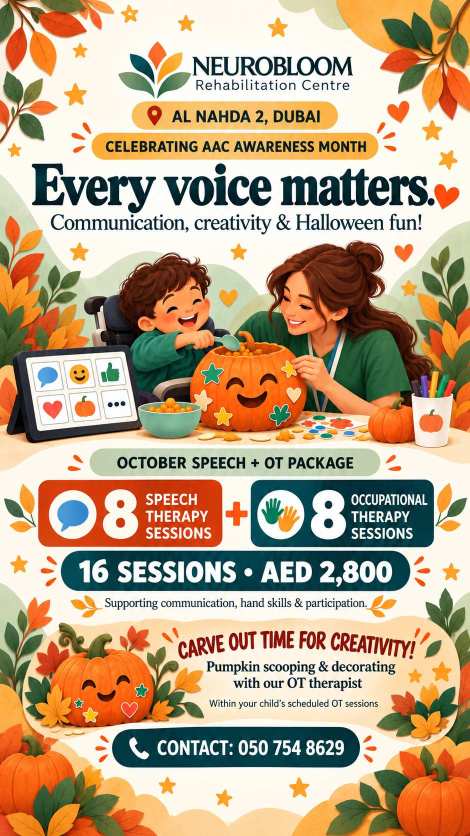
Watching your child face difficulties with tasks that seem to come easily to their peers can be a deeply isolating and emotional experience for any parent. Whether it is a toddler struggling to hold a spoon, a preschooler overwhelmed by the noise of a crowded playroom, or a school-aged child who cannot sit still long enough to complete a simple drawing, these everyday hurdles are often signs of underlying developmental or sensory processing challenges. When a child’s nervous system struggles to organize and respond to sensory input, or when fine motor planning delays disrupt their physical coordination, the resulting frustration frequently leads to emotional meltdowns, low self-esteem, and social withdrawal. If you are navigating these vulnerabilities, finding dedicated Occupational Therapy for Kids in Al Nahda Dubai is the vital turning point that turns everyday struggles into confident, independent milestones.
At Neurobloom Rehabilitation Center, we believe that every child deserves to interact with their world with total ease and joy. An occupational delay or sensory processing variance is not a behavioral choice or a stubborn refusal to cooperate; it is a clear biological indicator that your child’s brain and body require specialized scaffolding to work together efficiently. Our certified pediatric occupational therapists look past surface-level non-compliance to thoroughly analyze how your young learner receives, interprets, and responds to environmental stimuli. By designing highly tailored, play-integrated therapeutic interventions, we help children build the foundational motor, sensory, and cognitive skills they need to navigate home, school, and social settings with genuine confidence.
Maintaining a consistent therapy schedule should never add unnecessary administrative friction or emotional stress to your family’s busy weekly routine. In a highly active, fast-growing community like Al Nahda Dubai, balancing specialized healthcare appointments with school runs and professional commitments requires a truly convenient, local care network. Accessing elite clinical intervention right along your standard travel routes ensures your child can transition smoothly from home or nursery straight into their session without the exhausting fatigue of a lengthy cross-city drive. This local accessibility keeps your young learner’s nervous system calm, regulated, and perfectly primed to engage and learn.
Shifting from Family Frustration to Precision Clinical Strategy
Moving a child from a state of constant environmental defensiveness to a place of focused balance requires a careful shift from open-ended parental anxiety to a highly targeted, data-driven clinical strategy. In a dynamic home or group learning environment, a child with subtle fine motor planning gaps or sensory sensitivities operates under continuous neurological strain. A simple everyday task—such as managing clothing buttons, zipping up a school bag, or coping with the background hum of an air conditioner—can inadvertently trigger a fight-or-flight survival response. Clinically, sudden behavioral meltdowns, absolute task avoidance, or physical passivity are protective mechanisms deployed by an overloaded nervous system trying to cope with an environment it cannot accurately process.
Our advanced clinical methodology at Neurobloom Rehabilitation Center replaces diagnostic uncertainty with objective, evidence-based therapeutic pathways. Our licensed pediatric specialists carry out comprehensive evaluations of each child’s vestibular (balance), proprioceptive (body awareness), visual-motor integration, and fine motor systems to pinpoint exactly where developmental breakdowns occur. We then break complex physical and behavioral goals down into micro-steps, utilizing positive reinforcement and specialized therapeutic play to build core physical endurance, hand dexterity, and attention spans. This highly structured, empathetic approach ensures that the functional milestones achieved within our low-arousal therapy rooms naturally transfer over into real-world settings, enabling children to navigate variable routines and peer interactions with total ease.
Why Families Choose Neurobloom
Parents across the community place their deepest trust in Neurobloom Rehabilitation Center because we completely reject generic, assembly-line therapy templates. We recognize that every young learner’s developmental path must be treated with absolute clinical individuality.
- Integrated Multidisciplinary Oversight: Our advanced facility removes the stress of fragmented care by housing pediatric occupational therapists, certified behavior analysts (BCBAs), and speech-language pathologists under one collaborative roof for unified, comprehensive care planning.
- Low-Arousal, Child-Centered Spaces: We have intentionally engineered our therapy rooms to act as a calming sanctuary from urban sensory noise, utilizing soothing neutral colors and advanced sensory integration equipment to help sensitive children feel completely secure.
- The Dubai-Sharjah Gateway Advantage: Situated perfectly at the vital intersection of Dubai and Sharjah, our clinic cuts down on exhausting travel times, offering families premier medical-grade support directly along their standard daily commuting paths.
- Empathetic Caregiver Collaboration: We consider parents our core therapeutic partners. Every intervention track includes personalized, hands-on coaching and realistic home action plans, ensuring you feel fully equipped to encourage your child’s growth during weekend outings or family time.
Understanding the Challenge: Core Signs and Symptoms
Recognizing when a child requires structured occupational support involves looking closely at persistent patterns that stand in the way of daily participation, self-care routines, and age-appropriate learning. When a young child faces hidden gaps in processing internal sensory input or coordinating complex muscle groups, the pressure to conform to daily expectations can quickly become overwhelming.
If your young learner regularly exhibits several of the following developmental behaviors, exploring structured programs for Occupational Therapy for Kids in Al Nahda Dubai can bring vital clarity and relief to your entire household:
- Fine Motor and Graphomotor Lags: Severe difficulty or absolute avoidance when attempting to hold writing tools, use blunt safety scissors, manipulate clothing fasteners, or string small beads together.
- Postural Instability and Low Core Strength: Frequently slumping over tables, leaning heavily against walls or peers during floor time, or showing rapid physical exhaustion during brief tabletop activities due to weak core muscles.
- Sensory Processing Variations: Becoming intensely distressed, covering ears, or demonstrating aggressive meltdowns in response to standard ambient noises, bright lighting, or distinct food and clothing textures.
- Poor Visual-Spatial and Body Awareness: Frequently bumping into nearby objects or furniture, misjudging distances, struggling to stay within the lines while coloring, or appearing exceptionally clumsy during physical play.
- Severe Transition Anxiety and Rigidity: Displaying prolonged behavioral resistance, crying spells, or complete non-compliance when required to shift focus from a preferred play activity to a structured daily task like mealtimes or bedtime.
The Path to Progress: Cultivating Self-Regulation and Daily Autonomy
The primary goal of our specialized pediatric occupational therapy programming is to replace everyday frustrations with independent, self-directed capabilities. By breaking down complex motor, sensory, and communicative goals into tiny, achievable steps, we help your child build a strong foundation for lifelong learning. Through carefully measured positive reinforcement and specialized physical exercises, our therapists teach children how to accurately organize environmental data, maintain their focus, and coordinate their movements with absolute precision.
As children advance through our comprehensive development plans, families routinely witness deeply moving transformations in their overall confidence and classroom readiness. Children learn to accurately recognize their own internal states of overstimulation before it manifests as an explosive breakdown, confidently using tailored calming tools, visual schedules, or verbal phrases to request a necessary break. Over time, these hard-won clinical milestones translate into elevated school performance, authentic peer friendships, significantly reduced parental anxiety, and a genuinely cooperative household where every family member can thrive.
Hyper-Local Convenience for Al Nahda Families
Located perfectly inside the vibrant Dubai-Sharjah gateway, the Al Nahda Dubai district is a highly dynamic, family-centric community where residents deeply appreciate premium clinical care that respects their time. Driving long distances through heavy traffic with an easily overwhelmed or sensory-sensitive child can cause immense stress before a session even begins. That is why our strategic positioning near major regional transit veins like Al Nahda Street, Al Ittihad Road (E11), Amman St, Beirut St, Damascus St, and Baghdad St provides an incredibly smooth, stress-free commute for local families.
Our close proximity to key community landmarks means you can easily weave essential clinical care into your established weekly routines. Whether you are dropping older siblings off at top-tier neighborhood institutions like Al Ittihad Private School, MSB Private School, or The Sheffield Private School, running household errands at Sahara Centre, Century Mall, or Lulu Hypermarket, or heading out for a soothing, low-sensory afternoon walk around the shaded paths of Al Nahda Pond Park or the breezy walkways of Al Mamzar Beach Park, our clinic remains perfectly on your way. With plentiful RTA parking options directly surrounding our modern facility and quick public transit links via the Stadium Metro Station and Al Qusais Metro Station on the Green Line, visiting our pediatric specialists is consistently stress-free and reliable.
The Critical Importance of Early Support
When a child shows clear signs of a neurodevelopmental delay or sensory processing barrier, adopting a passive “wait and see” approach can mean missing out on the most influential period of neural adaptability they will ever experience. During the first six years of life, the human brain undergoes a massive explosion of synaptic formatting. This makes the early childhood years a golden window where targeted clinical therapies can alter and optimize a child’s long-term neurological architecture far more efficiently than at any later stage in life.
Choosing professional developmental support early completely reshapes your child’s academic and social path. By addressing sensory challenges and building emotional regulation before formal schooling starts, you protect them from the emotional toll of academic anxiety, low self-esteem, and social isolation. Early occupational therapy support builds a rock-solid foundation for focus, fine motor planning, and resilience, ensuring your child walks into their first classroom fully equipped to learn, play, and thrive right alongside their peers.
Frequently Asked Questions
What exact areas are evaluated during my child’s initial occupational therapy assessment?
Our comprehensive evaluation takes a close look at a wide range of functional skills your child needs for daily life. We measure fine motor control, pencil grasp, and scissor usage, alongside visual-perceptual tracking and bilateral coordination. Our specialists also assess sensory processing profiles, core strength, attention spans, and how well your child transitions between different tasks without emotional distress.
How does occupational therapy directly help a child who is a highly “picky eater”?
Extreme picky eating is often rooted in sensory processing difficulties, where certain food textures, smells, or temperatures feel completely overwhelming to a child’s nervous system. Our occupational therapists utilize gentle, systematic desensitization techniques and oral-motor play to help children explore new foods at their own comfortable pace, gradually expanding their diet while reducing mealtime anxiety for the whole family.
How does occupational therapy improve classroom attention spans and focus?
Often, what looks like a lack of focus in class is actually a child struggling with poor core stability or sensory overload. If a child’s muscles are working too hard just to keep them upright at a desk, they have less mental energy left to concentrate on the teacher. We work systematically to build shoulder, back, and core strength while using sensory strategies to help them feel physically grounded, which naturally increases attention spans.
How many hours of therapy per week will my child need to see stable progress?
Because every child’s neurodevelopmental blueprint is completely unique, frequency recommendations are determined strictly following a comprehensive initial clinical assessment. Most children see the most stable, compounding progress when participating in structured, customized sessions 2 to 3 times per week, allowing for the consistent clinical repetition needed to solidify new motor planning and self-regulatory habits.
You do not have to carry the emotional weight of navigating your child’s behavioral hurdles or developmental delays in isolation. At Neurobloom Rehabilitation Center, our compassionate, highly qualified team of pediatric experts is completely prepared to provide the precise clinical frameworks, personalized guidance, and dedicated support for Occupational Therapy for Kids in Al Nahda Dubai that your young one needs to truly thrive. Take a decisive, life-changing step toward establishing a balanced, successful, and independent academic future for your child. Explore our full range of specialized pediatric services by visiting our digital platform at http://neurobloomrehab.com/ or call our specialists directly at +971 50-754-8629 to schedule your initial comprehensive developmental evaluation today.