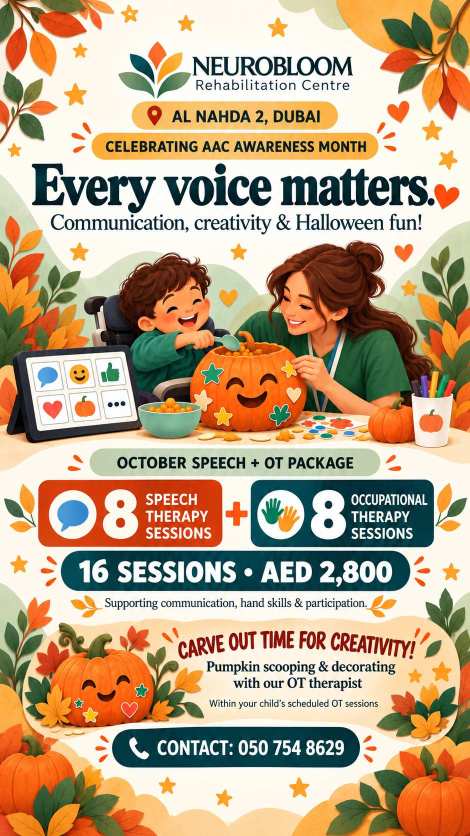
Expressive language delay occurs when a child has difficulty communicating their thoughts, needs, and feelings through spoken words or gestures, despite having the cognitive desire to interact. This is often linked to challenges in lexical retrieval or syntactic formulation—essentially, the brain’s “filing system” for words is disorganized. Therapy focuses on stimulating the Broca’s area of the brain, the region responsible for speech production, through repetitive, high-interest linguistic modeling.
During sessions, we utilize functional communication training. We don’t just teach labels; we teach “power words” that give the child agency over their environment. By reducing the frustration of not being understood, we prevent the secondary behavioral meltdowns that often accompany expressive delays. Whether your child is struggling to tell you about their day at a Sharjah nursery or asking for their favorite snack, we bridge the gap between thought and expression.
The “Commentary, Not Questions” Technique
Avoid the “Testing Trap” where you ask your child “What’s this?” repeatedly. Instead, act like a sports commentator during your weekend trips to Al Mamzar Park. Describe what you are doing: “I am pouring the sand. I am building a tower. Oh, the tower fell!” This provides a rich linguistic map without the pressure of a “correct” answer, encouraging the child to join in when they are ready.
Specialist FAQ
- My child understands everything but won’t talk. Is this a delay? Yes, this is a classic expressive delay. Their “receptive language” (understanding) is intact, but their “expressive language” (output) needs targeted support.
- Is screen time causing the delay? While passive screen time doesn’t “cause” a neurological delay, it replaces the active “serve and return” interaction needed for speech. We suggest limited, co-viewed media.
- What is the “wait and see” approach? Modern clinical research discourages “wait and see.” Early intervention during the peak neuroplasticity years (ages 2-5) yields the fastest and most permanent results.
Your child has a voice; we’re here to help them find it. Contact us at 0507548629 or visit Neurobloom Rehabilitation Centre, Al Nahda 2, Dubai, to begin their expressive journey today.