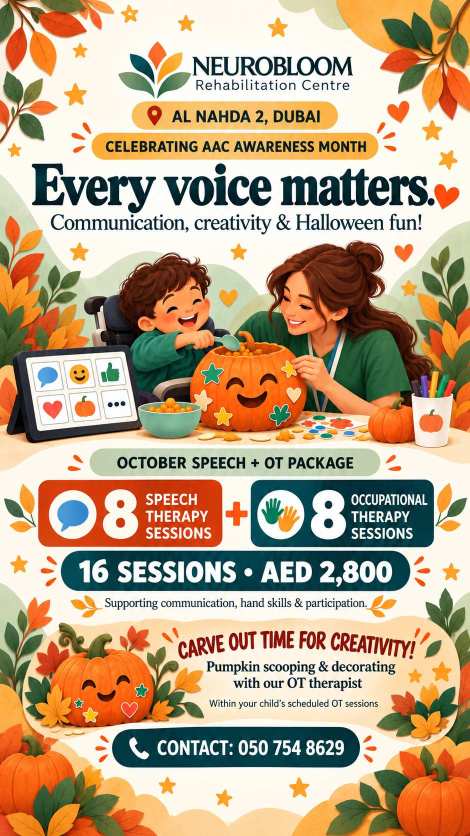
Discovering that your child is struggling to communicate their thoughts, mispronouncing words, or falling behind their peers in language milestones can be a deeply concerning experience for any parent. In a vibrant, fast-paced residential and educational hub like Al Qusais, communication is the primary bridge to a child’s social and academic success. When that bridge is compromised by a speech delay, stuttering, or an articulation disorder, the daily impact resonates throughout the entire household. Simple routines can become fraught with frustration as a child struggles to express basic needs, often leading to emotional meltdowns that leave parents feeling isolated and overwhelmed.
At Neurobloom Rehabilitation Center, we recognize that your child’s voice is their most powerful tool for navigating the world. Our specialized programs for Speech Therapy for Kids in Al Qusais are meticulously designed to transform these early communicative hurdles into moments of pride and connection. Situated just minutes away from the heart of your neighborhood, our center provides a warm, world-class clinical sanctuary where families receive highly individualized, evidence-based speech and language interventions. By bringing elite therapeutic standards directly to your local area, we remove the burden of exhausting cross-city travel, allowing your child to focus their energy entirely on finding their unique, confident voice.
We approach pediatric speech therapy not as a rigid clinical chore, but as a collaborative, deeply transformative journey. Our team understands that behind every vocabulary milestone or articulation victory is a family seeking clarity, guidance, and peace of mind. By integrating cutting-edge linguistic science with a compassionate, child-centered approach, we ensure that every young learner who walks through our doors feels fundamentally understood, safe, and motivated to expand their communication skills.
Connecting Narrative
From a precise neurodevelopmental perspective, language acquisition is an extraordinarily complex cognitive framework that requires the seamless integration of auditory processing, oral-motor planning, and social-pragmatic sequencing. When a child presents with a speech or language variance, their central nervous system is experiencing a specific breakdown in these underlying pathways. Our licensed speech-language pathologists (SLPs) approach these challenges by utilizing advanced, data-driven therapeutic protocols tailored to the unique neurological profile of each child. We meticulously evaluate phonetic placement, receptive comprehension, and expressive syntax, breaking down complex linguistic milestones into highly encouraging, measurable steps that stimulate new neural pathways in the brain’s language centers.
Shifting from this objective, clinical science into the lived reality of family life requires a deep layer of human empathy and vulnerability. We understand that parents do not look at their children as a collection of clinical symptoms or standardized test data. You see a bright, highly capable mind that is temporarily locked behind a communication barrier. At Neurobloom, our multidisciplinary team balances rigorous clinical authority with authentic human heartfulness. We treat every child with the absolute dignity they deserve, structuring our play-based interventions to preserve their vibrant personality and natural joy. We work side-by-side with parents, demystifying the therapeutic process and providing clear, manageable home strategies that turn daily family routines into natural opportunities for continuous language growth.
Why Families Choose Neurobloom
Families across the Al Qusais and Al Nahda communities place their trust in Neurobloom Rehabilitation Center because we have completely moved away from the cold, sterile, and intimidating environment common to traditional medical facilities. Our boutique clinic is custom-engineered with a warm, sensory-friendly, and deeply comforting layout that immediately lowers a child’s baseline anxiety. By utilizing soft, indirect natural lighting, low-arousal color palettes, and highly organized, predictable therapy spaces, we minimize automatic nervous system overwhelm, creating an ideal neurological environment where children feel secure enough to explore new sounds and vocalize their thoughts.
Furthermore, our clinical model is built upon a foundation of multi-disciplinary synergy that treats the whole child. We recognize that speech and language challenges rarely exist in complete isolation; they are frequently intertwined with underlying sensory processing differences or behavioral frustrations driven by an inability to communicate. Our DHA-licensed speech therapists work in constant, daily collaboration with our expert pediatric occupational therapists and certified behavior analysts. This comprehensive framework, combined with our affordable care structures and intensive parent-coaching blueprints, ensures that every developmental breakthrough achieved within our center is permanently maintained, generalized, and celebrated in the real world.
Understanding the Challenge
Speech, language, and social communication difficulties manifest in deeply unique ways across a child’s early developmental timeline, and recognizing these subtle early indicators is the absolute first step toward unlocking their potential. In toddlers and young children, these variances often present as a complete absence of meaningful words by 18 months, a persistent lack of response to their own name, or a visible inability to follow simple, one-step household instructions. A child might rely exclusively on physical gestures, pulling a caregiver’s hand toward an item, or throwing intense tantrums because they cannot find the linguistic tools to explain a basic physical or emotional need.
As children approach preschool and school ages, the barriers often shift toward articulation difficulties, phonological patterns, or social-pragmatic challenges. A child might frequently substitute sounds—such as saying “tat” instead of “cat”—making their verbal expressions highly unclear to unfamiliar adults, extended family members, or classmates. They may struggle to maintain conversational turn-taking, repeat phrases mechanically without functional intent, or display significant stuttering and sound-blocking when trying to speak. These mounting communicative hurdles can quickly trigger social isolation, low self-esteem, and academic anxiety, serving as a clear indicator that your child’s linguistic architecture requires professional, structured therapeutic support.
The Path to Progress
Our comprehensive clinical pathway is strategically designed to transform these daily communicative frustrations into sustainable milestones of clear, confident self-expression. Through highly customized sessions for Speech Therapy for Kids in Al Qusais, our clinicians transform necessary linguistic exercises into deeply engaging, motivating games. We utilize robust positive reinforcement to expand your child’s expressive vocabulary, refine their articulation patterns, and build durable sentence structures, ensuring that the process of learning to speak becomes an inherently joyful and empowering experience.
By integrating structured peer-pairing and social-pragmatic communication groups within our controlled clinic, children get to practice the delicate art of cooperative play, active listening, and conversational peer exchanges in a safe space. Simultaneously, for children who require non-verbal support, our team focuses on introducing functional communication alternatives, including Picture Exchange Communication Systems (PECS) and high-tech Augmentative and Alternative Communication (AAC) devices. Over time, this multi-layered therapeutic scaffolding eliminates communication-driven meltdowns, unlocks a healthy sense of personal autonomy, and fully prepares your child to enter inclusive school classrooms with absolute independence.
Hyper-Local Convenience
The strategic geographic location of Neurobloom Rehabilitation Center offers an invaluable, stress-free logistical advantage for busy families seeking premium pediatric care. Located inside Suite No 407, Ahli House C, Al Nahda 2, our facility sits directly at the primary Dubai-Sharjah gateway. This prime neighborhood placement completely frees parents from spending long, exhausting hours navigating heavy traffic gridlock, allowing families residing throughout Al Qusais 1, Al Qusais 2, Al Qusais 3, and Al Nahda to access top-tier clinical care within a mere few minutes’ drive or transit ride.
This exceptional proximity allows parents to seamlessly integrate vital speech therapy sessions into their weekly lifestyle. A visit to our center can easily be paired with a calming, regulating family walk around the expansive green spaces and water features of Al Nahda Pond Park, providing an ideal natural setting for sensory decompression before or after a session. Our building is directly accessible via major local connecting arterial roads, including Amman Street, Beirut Street, Halab Street, and Damascus Street, with abundant, stress-free RTA public parking spaces surrounding the facility. For families utilizing public transit, the center boasts seamless connectivity via the Al Qusais Metro Station, DAFZA Metro Station, and Stadium Metro Station on the Green Line, heavily supported by local RTA feeder buses. This direct access allows parents to effortlessly coordinate therapy drop-offs while remaining close to familiar neighborhood landmarks, including Lulu Hypermarket Al Qusais, Grand Service Station, Sahara Centre, and prominent educational institutions like Star International School, Pristine Private School, and The Apple International School, making premium developmental support a natural, stress-free part of your daily routine.
The Importance of Early Support
The first five years of a child’s life represent a uniquely critical, time-sensitive window of cognitive development defined by peak neurological neuroplasticity. During this rapid developmental phase, a young child’s brain is forming synaptic connections at an unprecedented rate, making it uniquely receptive to speech, language, and communication interventions. Waiting for a child to simply “grow out of” a noticeable speech delay is a clinical risk that often allows developmental gaps to widen significantly, frequently leading to immediate academic difficulties, behavioral challenges, and deep social isolation by the time they reach formal primary school.
Investing in early speech therapy is one of the most proactive and profoundly transformative choices a parent can make for a neurodivergent child or one experiencing developmental variances. By actively addressing articulation disorders, language processing deficits, and social communication barriers during these formative years, you fundamentally optimize their long-term developmental trajectory. Early clinical intervention provides your young learner with a robust foundation of self-advocacy, emotional resilience, and essential early literacy skills, ensuring they can enter the wider world with absolute confidence, pride, and genuine personal independence.
Frequently Asked Questions
What are the primary indicators that my child needs speech therapy?
You should consider a speech evaluation if your child is not using single words by 18 months, struggles to follow simple commands, has speech that is difficult for family or strangers to understand at age 3, experiences frequent stuttering, or shows intense frustration when attempting to communicate their daily needs.
How long does a typical pediatric speech therapy program last?
Because every child’s neurological profile and communication goals are entirely unique, the duration of therapy varies. Following a comprehensive initial evaluation, our speech-language pathologists outline a customized treatment plan detailing the recommended frequency of sessions and clear milestone timelines.
Can speech therapy help with behavioral problems and tantrums at home?
Yes, absolutely. A significant percentage of behavioral meltdowns in young children are directly driven by communication frustration—when a child has complex thoughts and emotions but lacks the functional language tools to express them. By giving a child a reliable way to communicate, behavioral symptoms typically decrease dramatically.
How can parents reinforce speech therapy goals outside the clinic?
Parental partnership is essential for long-term success. Immediately following each session, our therapists provide actionable feedback and practical home plans. Parents can easily support language growth during everyday routines by descriptive talking during play, reading together daily, and using specific verbal modeling techniques taught by our clinicians.
Does your center accept insurance for pediatric speech therapy sessions?
We assist families by providing detailed clinical reports, diagnostic assessments, and properly formatted invoices required to submit reimbursement claims to major health insurance providers. Our intake team is always available to help guide you through the documentation process.
Every young child deserves a clear, confident voice to share their thoughts, express their feelings, and build meaningful connections with the world around them. If you are noticing persistent delays in your child’s speech development or are seeking dedicated, compassionate guidance, you do not have to walk this intricate path alone. Neurobloom Rehabilitation Center is here to provide the elite, evidence-based, and highly localized clinical solutions your family deserves to truly thrive. Take a definitive, life-changing step toward securing your child’s long-term social and academic success today. Discover the profound developmental and human difference of our dedicated care for Speech Therapy for Kids in Al Qusais. Explore our specialized, multi-disciplinary programs online at http://neurobloomrehab.com/ or connect directly with our compassionate clinical intake team by phone at +971 50-754-8629 to arrange your child’s initial comprehensive speech evaluation.